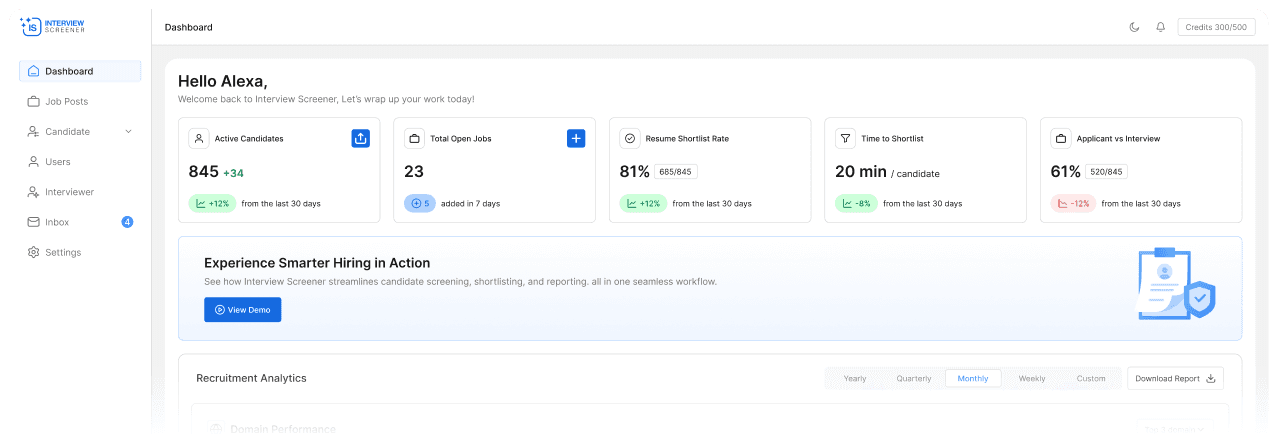

An Ai interviewer should not replace human judgment entirely. Our view is simple: the best hiring systems use an Ai interviewer to automate repetitive screening at scale while keeping human oversight for decisions that carry risk, nuance, and accountability. Full automation sounds efficient, but in practice it can weaken trust, candidate experience, and hiring quality.
We work in high-volume hiring, where speed matters and inconsistency is expensive. That is exactly why this conversation matters. Teams want faster shortlists, less manual scheduling, and more structured screening. An Ai interviewer can deliver all of that. But when companies chase total removal of people from the process, they often create new problems around fairness, explainability, escalation, and candidate confidence.
The real standard is not human versus machine. It is better process design. An Ai interviewer is most valuable when it handles the work humans struggle to do consistently at scale: asking every candidate the same role-specific questions, capturing structured responses, scoring against predefined criteria, and surfacing clear signals for recruiters and hiring managers. That is automation with purpose, not automation for its own sake.
What an Ai interviewer should actually do
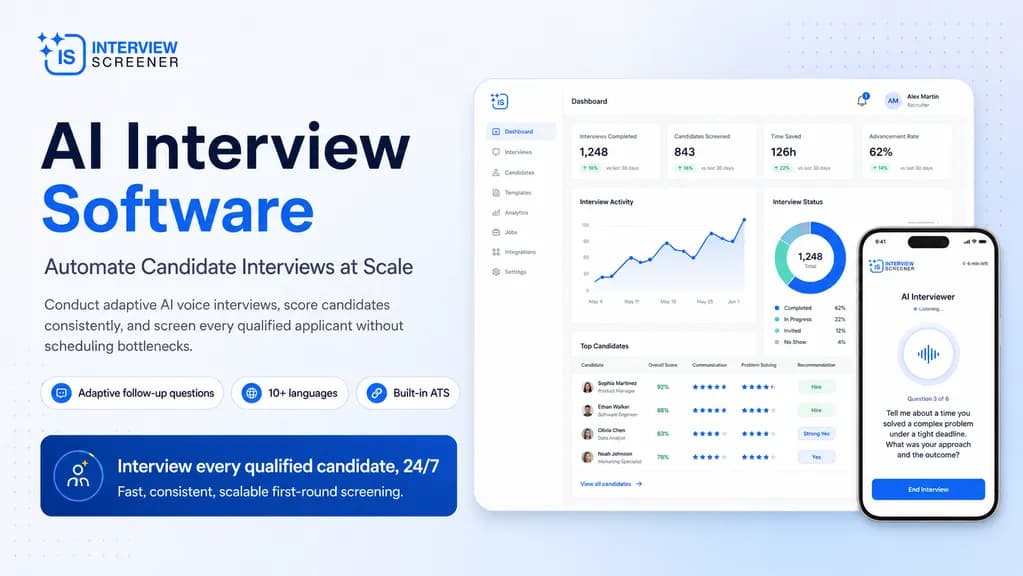
An Ai interviewer should take over the front end of screening with precision and consistency. That means running interviews automatically, day or night, without bottlenecks. It means giving every applicant the same starting point. It means turning unstructured first-round screening into repeatable evaluation.
In our experience, the strongest use of an Ai interviewer is operational. It removes friction from the earliest stage of hiring, where teams lose the most time and candidates experience the most delay. When designed correctly, it improves speed without compromising structure.
- Automate first-round interview delivery for every candidate
- Standardize questions across locations, recruiters, and roles
- Score responses against job-specific criteria
- Flag concerns, inconsistencies, or follow-up needs for review
- Create a documented, repeatable screening process
Those outcomes matter because early-stage hiring often breaks under volume. Recruiters are buried. Hiring managers are unavailable. Candidates wait. An Ai interviewer solves that throughput problem better than manual coordination ever will.
Why full automation fails even when an Ai interviewer performs well
This is the part many vendors avoid. An Ai interviewer can be excellent at conducting structured screening and still be the wrong tool for final decision autonomy. Hiring is not only a ranking exercise. It includes judgment calls, exception handling, context, and accountability. Full automation tries to flatten those realities into a score.
That creates several business risks. First, edge cases get mishandled. A candidate may communicate differently, have a nontraditional background, or answer with context that requires interpretation. Second, internal trust drops when teams do not understand why a recommendation was made. Third, candidate confidence can decline if the process feels closed, rigid, or impossible to question.
We believe an Ai interviewer should drive the process forward, not operate as an unchallengeable gatekeeper. Human review remains essential wherever nuance, exceptions, or downstream liability exist.
An Ai interviewer is powerful, but hiring still needs accountability
Accountability is where the fully automated vision starts to crack. If a candidate is rejected, someone inside the company must be able to explain the process, defend the criteria, and review unusual cases. An Ai interviewer can support that responsibility by documenting interviews and applying consistent standards. It should not erase that responsibility.
This is why our approach favors controlled automation. We automate the interview itself, the scoring workflow, and the comparison framework. Then we make it easier for hiring teams to review outcomes with confidence. That balance is what makes the system usable in the real world.
The human-in-the-loop model for an Ai interviewer
Human-in-the-loop does not mean dragging recruiters back into manual screening. It means placing human oversight at the moments that matter most. The Ai interviewer handles the repetitive workload. People handle adjudication, escalation, and final accountability.
For practical hiring teams, this model is stronger than full automation because it scales without becoming brittle. It protects speed while preserving judgment. It also aligns better with how organizations actually hire, where different stakeholders need visibility into why candidates move forward or stop.
- The Ai interviewer runs structured first-round interviews automatically
- The system scores candidates using predefined competencies
- Recruiters review flagged responses and borderline cases
- Hiring managers use structured outputs to guide next steps
- Final decisions remain reviewable and accountable
That is not a compromise. It is a more mature operating model. Companies do not need less automation. They need automation placed in the right part of the hiring workflow.
How an Ai interviewer helps reduce bias without pretending to eliminate it
Bias is one of the biggest promises attached to any Ai interviewer. It is also one of the most misunderstood. A structured interview process is better than an unstructured one because every candidate gets the same format, the same core questions, and the same scoring logic. That alone is a major improvement over inconsistent phone screens run by different people under time pressure.
Still, we should be honest. An Ai interviewer does not make hiring bias disappear by definition. What it can do is reduce inconsistency, enforce role-based criteria, and create a reviewable trail. That is meaningful progress. It is far more useful than marketing language that treats automation as magic.
In practice, a well-configured Ai interviewer supports fairer screening by narrowing the space for improvisation. It shifts teams away from gut feel and toward repeatable evaluation. Combined with human oversight, that produces a hiring process that is both more efficient and more defensible.
Why candidates respond better to a well-designed Ai interviewer
Candidates care about speed, clarity, and respect. A slow process feels careless. A vague process feels unfair. An Ai interviewer can improve all three when it is thoughtfully deployed. Candidates get immediate access to interviews, a consistent experience, and a faster path to resolution.
The mistake is assuming candidates only care whether a person was involved. In reality, many care more about whether the process is organized, responsive, and job-relevant. An Ai interviewer that asks focused questions and moves quickly can feel better than a rushed recruiter call that lacks structure.
That said, transparency matters. Candidates should understand where the Ai interviewer fits, what the interview is assessing, and how the results are used. Confidence grows when the process feels intentional rather than hidden.
What to look for in an Ai interviewer platform
Not every Ai interviewer is built for disciplined hiring operations. Some tools overpromise decision autonomy. Others automate scheduling but leave evaluation weak. The right platform should strengthen both efficiency and control.
- Role-specific interview flows that match real hiring criteria
- Structured scoring tied to competencies, not vague impressions
- Clear review paths for exceptions and escalations
- Consistent candidate experience across high-volume pipelines
- Reporting that helps teams compare candidates quickly
- Configuration options that support oversight, not blind automation
We built our approach around that reality. The goal of an Ai interviewer is not to simulate a human interviewer for its own sake. The goal is to remove delay, standardize screening, and surface better signals for the people responsible for hiring outcomes.
The real future of the Ai interviewer
The future is not a hiring process with humans deleted from it. The future is a process where an Ai interviewer handles the heavy screening load with consistency, speed, and structure, while people stay focused on judgment and accountability. That model is more scalable, more credible, and more resilient.
We see this every day. Teams do not need another partial automation layer that still depends on manual coordination. They also do not need an opaque system making irreversible hiring calls on its own. They need an Ai interviewer that fully automates screening interviews and supports a reviewable hiring process around them.
That is why full automation is the wrong goal. Better automation is the right one. An Ai interviewer should do a lot of the work, but not all of the thinking.
FAQ
What is an Ai interviewer?
An Ai interviewer is a system that conducts structured candidate interviews automatically, asks predefined questions, captures responses, and scores them against role-specific criteria. It is commonly used for first-round screening.
Can an Ai interviewer replace recruiters completely?
An Ai interviewer can replace a large amount of manual screening work, but it should not remove human oversight from hiring entirely. Recruiters and hiring managers still play a key role in exceptions, final decisions, and accountability.
Does an Ai interviewer reduce hiring bias?
An Ai interviewer can reduce inconsistency by standardizing questions and scoring. That helps create a more structured process. It should be paired with human review and clear criteria to support better outcomes.
Is an Ai interviewer good for candidate experience?
Yes, if it is designed well. An Ai interviewer can give candidates faster access to interviews, quicker turnaround, and a more consistent process. Clear communication about how the interview works is important.
Why is full automation the wrong goal for an Ai interviewer?
Because hiring includes nuance, edge cases, and accountability. An Ai interviewer is excellent for automating structured screening at scale, but fully automated decision-making can create trust, fairness, and explainability problems. The stronger model is automation with human oversight.