
Why an AI interview screening tool changes hiring at the first step
An AI interview screening tool automates early candidate evaluation with speed, structure, and consistency. We use it to replace manual screening with a process that is faster, more scalable, and easier to standardize, so hiring teams can reduce bias, save recruiter hours, and move stronger candidates forward without delays.
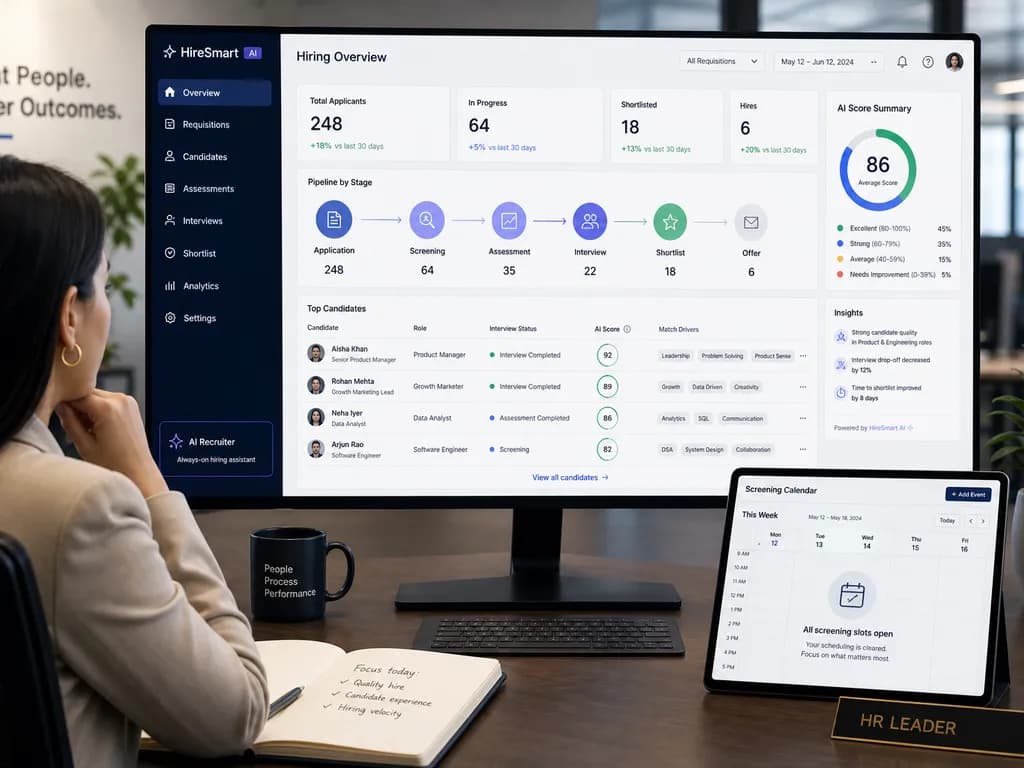
Most hiring teams do not struggle because they lack applicants. They struggle because the first stage is overloaded. Recruiters are buried in resumes, inboxes, scheduling, and repetitive screening calls. Good candidates wait too long. Weak fits consume time anyway. An AI interview screening tool solves that bottleneck by conducting structured interviews automatically, scoring responses against role criteria, and giving our teams a clearer signal earlier in the funnel.
At Interview Screener, we built our platform around one idea: screening should not depend on recruiter availability. It should run continuously, consistently, and at scale. That is what an AI interview screening tool does best. It creates a repeatable first interview experience, captures candidate responses in a structured format, and turns fragmented early-stage hiring into an operational advantage.
What an AI interview screening tool actually does
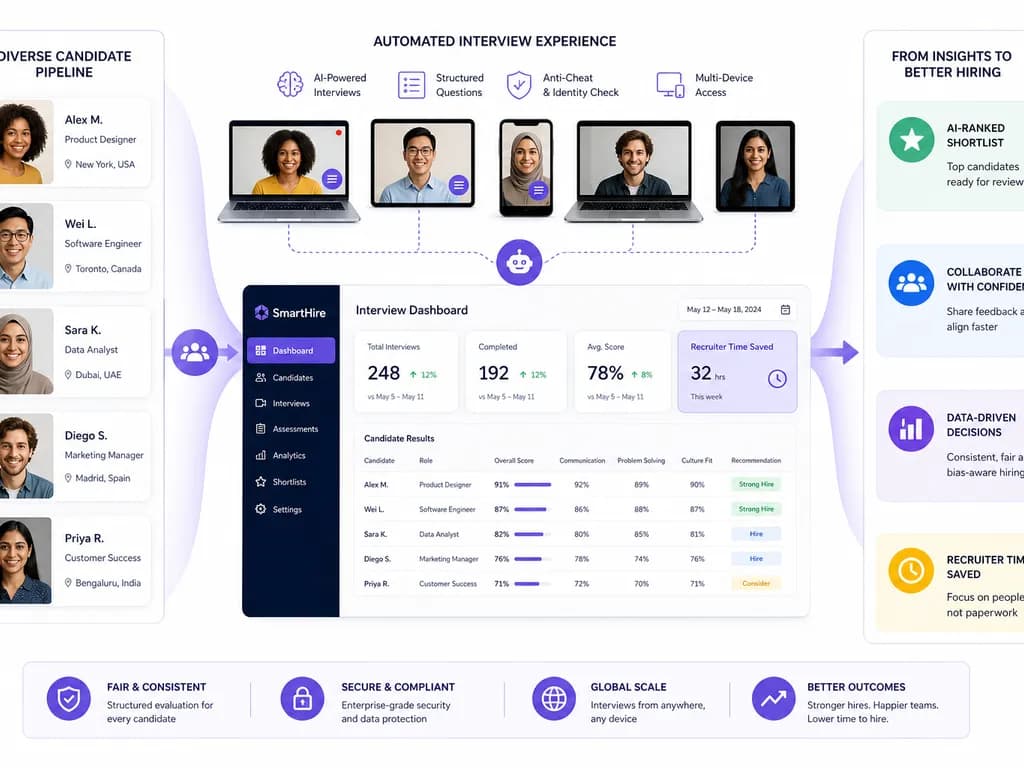
An AI interview screening tool is not just a chatbot with hiring language. Done properly, it is a full screening system that interviews candidates, asks role-specific questions, evaluates responses against predefined requirements, and produces a standardized view of fit. It replaces the most repetitive part of recruiting with an always-on process.
In practice, our AI interview screening tool can launch interviews instantly after application, guide candidates through consistent question flows, and assess answers using the competencies that matter for the role. Instead of relying on rushed phone screens and uneven note-taking, teams get a comparable record for every candidate.
- Automates interview invitations and screening flow
- Asks consistent, role-aligned questions
- Evaluates answers against hiring criteria
- Ranks or segments candidates for next steps
- Removes scheduling friction from early screening
- Creates a documented, repeatable decision trail
That consistency matters. When the first interview is manual, quality varies by recruiter workload, interview style, and time pressure. An AI interview screening tool gives every applicant the same starting line. For HR leaders trying to improve fairness while handling volume, that is a major operational shift.
Why teams adopt an AI interview screening tool
Three pressures drive adoption. Time. Scale. Consistency. Hiring teams are expected to move fast without sacrificing quality. Yet the first stage is where momentum usually breaks. We see recruiters lose hours every week to tasks that do not improve decision quality. An AI interview screening tool removes that drag.
Time is the most obvious gain. Screening calls, scheduling emails, no-shows, and note consolidation create heavy administrative load. With an AI interview screening tool, candidates can complete interviews on demand, and hiring teams can review standardized outputs instead of starting from scratch each time.
Scale is the second issue. A hiring process that works for twenty applicants often fails at two hundred. Volume exposes every weak point. An AI interview screening tool handles spikes without adding interviewer capacity, which helps teams maintain response speed during urgent growth or seasonal hiring.
Consistency is the third. Human-led screening can drift. Questions change. Criteria blur. Decisions become harder to defend. Our approach with an AI interview screening tool keeps the process structured, which is especially valuable when multiple recruiters or hiring managers are involved.
How an AI interview screening tool reduces bias through structure
Bias in hiring often enters through inconsistency. Different candidates get different questions. Some interviewers dig deeper. Others rely on instinct. Notes are selective. Memory is uneven. An AI interview screening tool helps reduce those risks by introducing a structured screening environment where each candidate is assessed through the same framework.
We are careful here. The value is not in pretending hiring can be made perfect. The value is in reducing avoidable variation at the exact stage where variation is common. An AI interview screening tool supports fairer comparison because it standardizes prompts, captures responses in a consistent format, and ties evaluation back to role requirements rather than interviewer mood or availability.
For HR teams, this makes screening easier to review and improve. If candidate quality is slipping, criteria can be adjusted. If questions are not producing useful signal, they can be rewritten. An AI interview screening tool turns screening into a process that can be audited and refined, instead of a loose collection of individual habits.
What structured screening improves
- Candidates answer the same core questions
- Evaluations are based on predefined competencies
- Reviewers compare like with like
- Interview quality no longer depends on calendar pressure
- Teams can monitor and improve screening criteria over time
Where an AI interview screening tool delivers the biggest ROI
The strongest return usually appears in high-volume and time-sensitive hiring. When roles attract large applicant pools, manual screening slows everything down. An AI interview screening tool restores speed at the top of the funnel, where delays are most expensive. It also improves recruiter capacity by shifting effort from repetitive calls to higher-value evaluation and stakeholder alignment.
We also see strong impact in distributed hiring environments. If multiple locations or business units are hiring at once, process drift becomes a real problem. An AI interview screening tool gives those teams one operating model for first-stage interviews, which protects quality even when hiring is decentralized.
Another ROI driver is candidate experience. Applicants want momentum. They do not want to wait days for a screening slot. With an AI interview screening tool, candidates can move forward when they are ready. That responsiveness helps employers stay competitive without increasing recruiter workload.
How we implement an AI interview screening tool for better hiring decisions
Technology alone does not fix screening. Design does. We implement an AI interview screening tool by starting with role clarity. What does success look like in this job? Which competencies matter at screening, and which should be saved for later-stage interviews? When those questions are answered properly, automation becomes useful instead of noisy.
Next comes interview design. Questions must be relevant, concise, and capable of producing signal. Our AI interview screening tool works best when screening is built around real hiring needs, not generic prompts. That means different workflows for customer support, sales, operations, technical roles, and leadership pipelines.
Then we define evaluation logic. Screening should separate must-haves from nice-to-haves. It should identify clear advancement criteria. An AI interview screening tool is most effective when recruiters and hiring managers agree in advance on what good looks like.
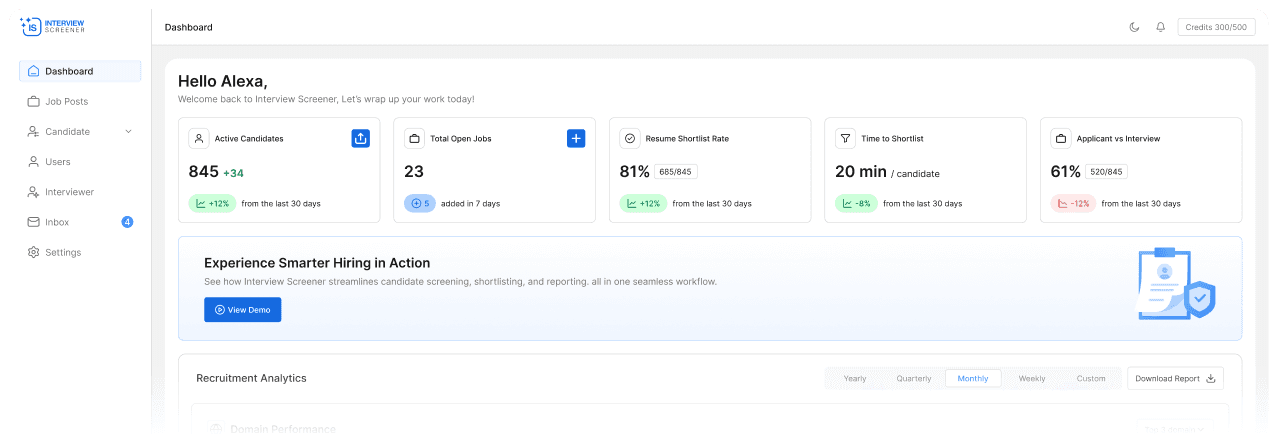
Finally, we operationalize the outputs. Scores alone are not enough. Teams need summaries, candidate comparisons, and a clean path to next steps. A well-deployed AI interview screening tool should fit into hiring operations naturally, not create another dashboard that recruiters have to interpret manually.
Implementation priorities we recommend
- Define role-specific screening criteria before launch
- Use structured questions tied to actual job success
- Separate knockout requirements from ranked attributes
- Align recruiters and hiring managers on review standards
- Monitor candidate outcomes and refine the workflow regularly
Choosing the right AI interview screening tool
Not every AI interview screening tool is built for true automation. Some products assist recruiters. Others actually replace the manual screening step. That distinction matters. If your goal is to eliminate repetitive first interviews, the platform must do more than summarize applications. It must conduct interviews, evaluate responses, and move candidates forward without human intervention at the screening stage.
We believe the right AI interview screening tool should be judged on practical performance. Can it handle volume? Can it maintain consistency across roles? Can it produce structured, reviewable outputs? Can it support a better candidate experience while reducing recruiter burden? If the answer is yes, it is creating operational value, not just adding a layer of software.
For organizations serious about hiring efficiency, an AI interview screening tool is no longer a nice-to-have experiment. It is becoming the most effective way to modernize the front end of recruitment. The teams that adopt it well create faster pipelines, clearer hiring signals, and a more controlled screening process from day one.
Final thoughts on the AI interview screening tool
An AI interview screening tool gives hiring teams a better first step. It automates interviews, standardizes evaluation, and removes the manual bottlenecks that slow recruiting down. We use an AI interview screening tool to help organizations screen faster, reduce inconsistency, and focus human attention where it matters most: final assessment, decision-making, and candidate engagement deeper in the process.
FAQ
What is an AI interview screening tool?
An AI interview screening tool is software that conducts and evaluates early-stage candidate interviews automatically. It replaces manual screening calls with a structured, scalable process.
How does an AI interview screening tool save recruiter time?
It removes scheduling, repetitive first interviews, and manual note-taking from the screening stage. Recruiters spend less time on administration and more time reviewing qualified candidates.
Can an AI interview screening tool help reduce bias?
Yes. An AI interview screening tool can reduce inconsistency by asking the same core questions, applying the same evaluation framework, and creating a more structured basis for candidate comparison.
Who benefits most from an AI interview screening tool?
High-volume hiring teams, growing organizations, and companies with distributed recruiting operations often see the greatest benefit because they need speed, consistency, and scale at the top of the funnel.
What should we look for in an AI interview screening tool?
Look for true interview automation, role-specific workflows, structured candidate evaluation, strong scalability, and outputs that help recruiters make faster, clearer next-step decisions.