

The Future of Engineering Recruitment: Scaling with Autonomous AI Interviews
Autonomous AI Interviews are becoming the clearest path to scaling engineering recruitment without sacrificing rigor, speed, or consistency. We see this firsthand. High-growth engineering teams need a way to evaluate deep technical capability at volume, and Autonomous AI Interviews make that possible by automating structured screening from first touch to final shortlist.
Engineering hiring has changed faster than most recruiting systems were built to handle. Demand spikes. Talent markets shift. Candidate pipelines expand across regions and time zones. Meanwhile, hiring teams are still expected to identify real technical ability, communication strength, and role alignment with precision. That expectation collides with reality when screeners are manual, inconsistent, slow, and expensive to scale.
This is where Autonomous AI Interviews move from interesting concept to operating model. Instead of relying on recruiters or engineers to conduct repetitive first-round screens, we automate the interview process itself. Candidates engage with a structured, intelligent interview flow that assesses role-specific competencies, asks follow-up questions, captures depth of reasoning, and generates standardized evaluation outputs without human intervention during the screening stage.
For engineering organizations, this matters because technical hiring fails when early-stage screening is shallow. Resume filters miss nuance. Generic recruiter calls rarely validate engineering judgment. Overloaded hiring managers do not have time to conduct dozens of exploratory calls every week. Autonomous AI Interviews solve that bottleneck by turning the first interview into a repeatable, measurable, always-on assessment layer.
Why engineering recruitment is breaking under traditional screening models
Most engineering recruitment workflows were designed for lower complexity roles and lower application volume. They depend on human availability at every stage. A recruiter reviews resumes. A coordinator schedules a call. A screener asks a fixed set of questions. Notes vary in quality. Candidate comparisons become subjective. Delays build. Strong engineers drop out. Weak fits advance because they interviewed on a good day with the right person.
The deeper problem is not just speed. It is signal quality. Engineering teams are not hiring for polished resumes alone. They are hiring for problem framing, system thinking, tradeoff awareness, technical communication, and applied experience in specific environments. Traditional screens rarely capture those dimensions in a consistent way.
We have built Autonomous AI Interviews specifically to address that gap. Instead of treating screening as a calendar event, we treat it as an intelligence layer. Every candidate is interviewed using the same role-calibrated logic. Every answer is evaluated against the same competency framework. Every hiring team receives structured outputs they can trust.
That consistency changes the economics of hiring. It reduces the burden on recruiters. It gives engineers fewer but better downstream interviews. It shortens time to shortlist. It also creates an audit trail of how each candidate was assessed, which is critical when teams need fairness, defensibility, and operational clarity.
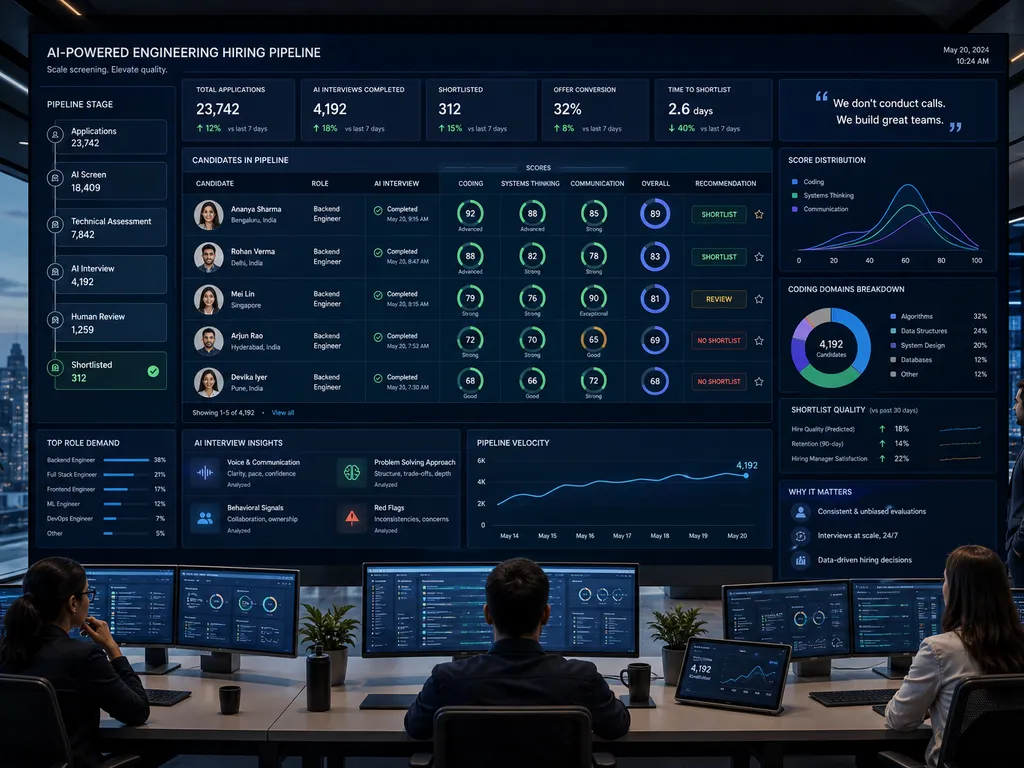
How Autonomous AI Interviews assess complex technical skills without human intervention
The phrase matters here. Autonomous AI Interviews are not just chat interfaces asking generic questions. To work in engineering recruitment, they must operate like structured technical interviewers. That means understanding the role, adapting to candidate responses, probing for evidence, and evaluating substance rather than surface confidence.
In practice, we configure Autonomous AI Interviews around the competencies that predict success in a given engineering role. A backend engineer may be assessed on distributed systems familiarity, API design reasoning, observability habits, debugging methodology, database tradeoffs, and collaboration with product stakeholders. A machine learning engineer may be screened on feature pipeline judgment, model deployment constraints, experimentation discipline, and production reliability. A frontend engineer may be evaluated for component architecture, performance awareness, accessibility instincts, and state management decisions.
The interview flow is dynamic. If a candidate gives a broad answer, the system drills deeper. If they mention a past architecture decision, the interview can ask why they chose one pattern over another. If they claim ownership, the system can test for depth by exploring failure modes, metrics, bottlenecks, and lessons learned. This is the difference between collecting answers and actually screening for capability.
Autonomous AI Interviews also make technical screening more complete. Human screeners often rush. They skip follow-ups. They vary in technical fluency. They miss inconsistencies. Our system does not get fatigued, distracted, or constrained by packed calendars. It executes the full interview logic every time, which means each candidate gets a consistent opportunity to demonstrate skill.
What Autonomous AI Interviews evaluate in engineering candidates
- Applied technical depth, not just terminology recognition
- Decision quality under real engineering constraints
- Clarity of technical communication
- Evidence of ownership and execution in prior work
- Reasoning through ambiguity, tradeoffs, and failure scenarios
- Alignment between claimed experience and demonstrated understanding
This model is especially powerful in high-volume environments. Whether a firm is hiring ten platform engineers or hundreds of software developers across multiple locations, Autonomous AI Interviews maintain the same standard. The first candidate screened at 8 a.m. receives the same rigor as the hundredth candidate screened late at night.
Autonomous AI Interviews and the end of recruiter bottlenecks
Recruiting teams feel the pressure first. When applications surge, they become the human buffer for every delay in the process. Resume review expands. Scheduling becomes chaotic. Screen calls crowd out strategic work. Candidate experience suffers because no one can keep pace with inbound demand. Autonomous AI Interviews remove the most repetitive and operationally expensive part of that cycle.
Instead of scheduling hundreds of first-round calls, we allow candidates to complete interviews on demand. The system handles interview delivery, response capture, competency mapping, and scoring. Recruiters move from conducting screens to managing decision quality. That shift is important. It elevates the recruiting function from administrative throughput to strategic hiring orchestration.
Engineering leaders benefit just as much. Most do not want more calendar holds for preliminary screens. They want to spend time with candidates who already demonstrate relevant ability. Autonomous AI Interviews create that separation. Hiring managers can enter the process later, with stronger evidence and a narrower pool. This protects engineering time while improving confidence in the shortlist.
There is also a quality-of-hire advantage. Manual first rounds often reward charisma, familiarity, or interviewer preference. Autonomous AI Interviews center evaluation on structured criteria. That does not eliminate judgment later in the process, but it does improve the quality of the pipeline entering those later stages.
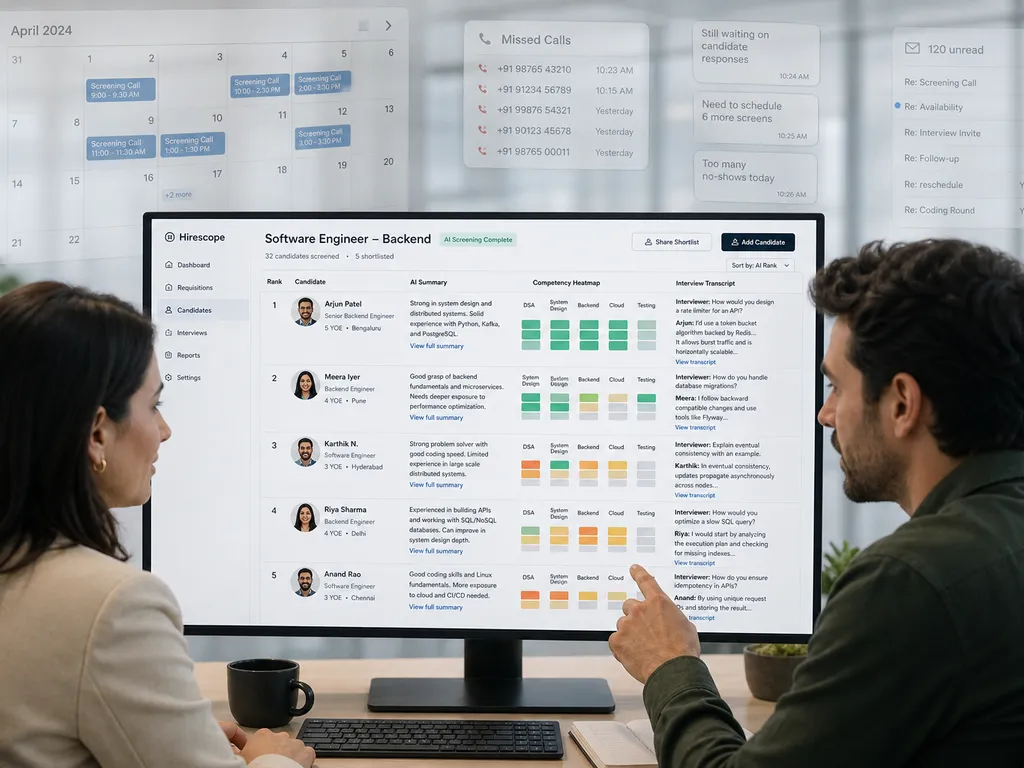
Scaling engineering hiring across regions, functions, and growth stages
Top-tier engineering firms rarely hire for one role in one market at one speed. They hire across business units, product lines, seniority bands, and geographies. A startup moving upmarket may need infrastructure engineers, security specialists, and technical support developers at the same time. A mature enterprise may be replacing attrition in one team while building a new AI function in another. Traditional screening cannot scale cleanly across that complexity.
Autonomous AI Interviews can. We structure interview frameworks by role family, level, and competency profile, then deploy them simultaneously across hiring streams. That allows organizations to preserve role-specific rigor without creating operational chaos. The candidate applying for a staff-level platform role receives a screening experience calibrated for architecture depth and influence. The graduate candidate applying for a junior software role receives an interview designed for fundamentals, learning ability, and communication.
This matters because scale without calibration creates noise. When every applicant gets the same interview, the output is misleading. When every role gets a custom human process, the system becomes unmanageable. Autonomous AI Interviews solve for both. They scale the process while preserving role relevance.
Another advantage is time zone independence. Engineering talent is global. High-performing candidates do not want to wait days for a screening slot. Autonomous AI Interviews are available when candidates are ready. That flexibility improves completion rates and keeps momentum high, especially in competitive hiring markets where delays are costly.
Operational gains from Autonomous AI Interviews at scale
- Faster movement from application to shortlist
- Consistent screening across countries and hiring teams
- Reduced recruiter workload during demand spikes
- Better use of engineering manager time
- Standardized candidate data for easier comparison
- A more responsive candidate experience without scheduling friction
When firms standardize first-round evaluation through Autonomous AI Interviews, they stop treating hiring as a sequence of meetings and start treating it as a scalable decision system. That is how recruitment keeps pace with engineering growth.
Bias reduction, fairness, and consistency in technical screening
Bias enters hiring early. It enters through resumes, assumptions, rushed conversations, interviewer inconsistency, and unstructured note taking. In engineering recruitment, those distortions are especially expensive because strong candidates are often missed before they ever meet the hiring manager. Autonomous AI Interviews create a more controlled screening environment.
We design Autonomous AI Interviews around predefined competencies, structured prompts, and consistent evaluation criteria. Every candidate for the same role is asked to demonstrate capability against the same framework. Follow-up questions are driven by response content and role logic, not by interviewer mood, familiarity, or unconscious preference. This creates a more equitable first-pass assessment.
Consistency also helps with defensibility. Hiring teams can review what was asked, how the candidate responded, and which competencies were evidenced. That is far stronger than relying on scattered notes from multiple screeners using different standards. It gives talent leaders a clearer basis for decisions and a cleaner path to continuous process improvement.
Fairness in engineering screening does not mean reducing rigor. It means applying rigor evenly. Autonomous AI Interviews support that by making sure the bar is defined, repeatable, and visible. Candidates are evaluated on relevant performance indicators, not on whether they happened to interview with the most technical recruiter or the most talkative hiring manager.
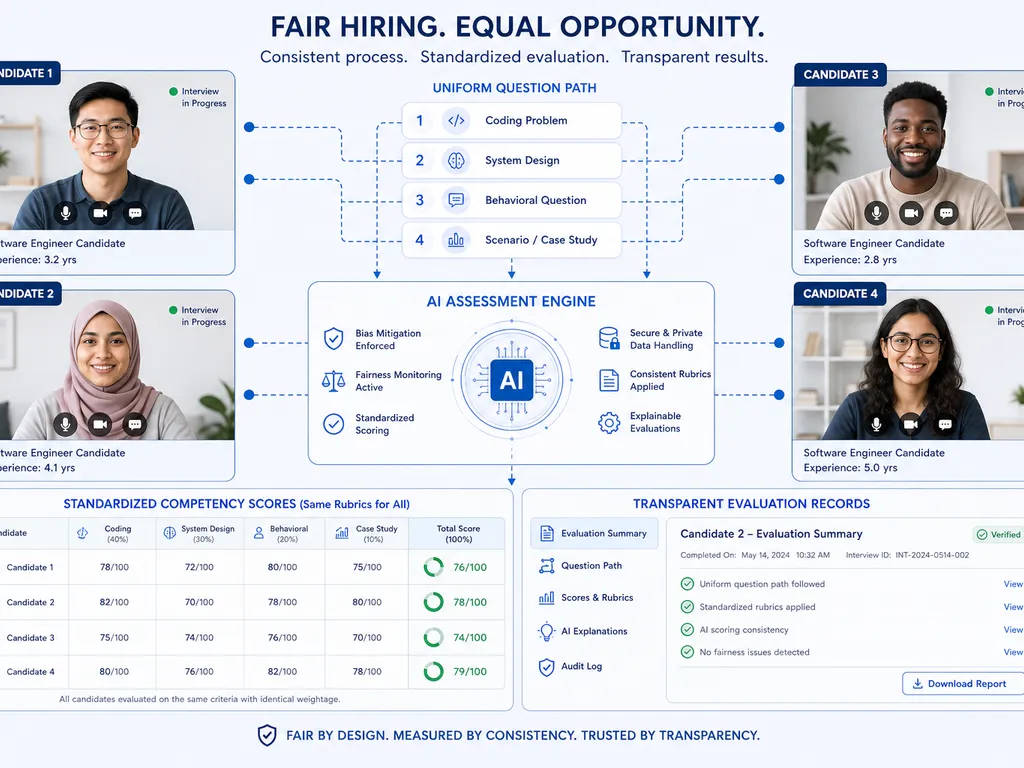
What engineering leaders actually gain from autonomous screening
The obvious gain is efficiency. The more important gain is decision quality. Engineering leaders need a screening layer that surfaces substance before human interviews begin. Autonomous AI Interviews provide that by converting raw candidate interactions into structured evidence. Instead of entering interviews with a resume and vague recruiter notes, managers enter with a competency-backed assessment of what the candidate has actually demonstrated.
That changes the downstream process. Technical panels can go deeper because they are not spending time on basic validation. Final interviews become more strategic because earlier stages have already established baseline capability. Hiring decisions become cleaner because teams are comparing candidates against shared evidence rather than fragmented impressions.
There is a significant financial effect as well. Manual screening consumes recruiter time, coordinator time, engineering time, and opportunity cost from hiring delays. Autonomous AI Interviews compress those costs. More importantly, they reduce the cost of weak funnel decisions. Advancing the wrong candidates into expensive later-stage interviews is one of the most common forms of hidden waste in engineering recruitment.
We also see a branding benefit. Candidates notice when a hiring process is organized, responsive, and relevant to the role. A well-designed autonomous interview gives them a clear sense that the company values structure and technical depth. That is better than waiting a week for a rushed fifteen-minute call that barely tests fit.
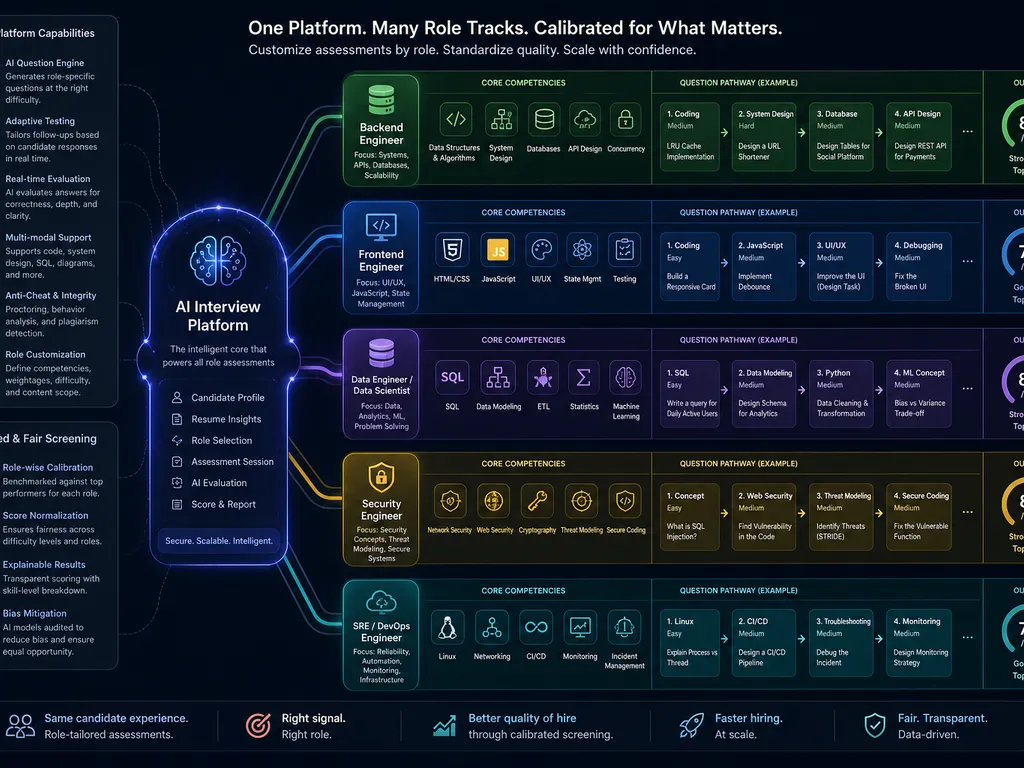
Designing Autonomous AI Interviews for different engineering roles
One reason some screening automation fails is that it treats all technical roles as variations of the same job. They are not. Engineering recruitment demands role-specific evaluation architecture. Autonomous AI Interviews work best when they reflect the actual work candidates will do.
For a site reliability engineer, screening should emphasize incident response judgment, monitoring strategy, automation instincts, service resilience, and postmortem thinking. For a data engineer, the interview should explore pipeline design, data quality controls, orchestration choices, storage tradeoffs, and stakeholder alignment. For a security engineer, the system should probe threat modeling, secure development practices, risk prioritization, and response workflows.
Seniority matters too. Junior candidates should not be screened as diluted versions of senior hires. They should be evaluated for fundamentals, growth potential, clarity of thought, and coachability. Senior engineers need a very different interview logic focused on architecture, influence, complexity management, and judgment under uncertainty. Autonomous AI Interviews allow that separation cleanly.
Role design principles we use for Autonomous AI Interviews
- Map each interview to actual job outcomes, not generic skill lists
- Separate foundational skills from advanced decision-making criteria
- Adapt follow-up questions based on candidate claims and depth
- Score against defined competencies with role-specific weighting
- Produce summaries that recruiters and engineering leaders can act on immediately
This is where automation becomes strategic. Autonomous AI Interviews are not replacing technical standards. They are operationalizing them at scale.
Implementation mistakes that weaken autonomous engineering screening
Not every automated hiring workflow produces value. Poor implementation creates noise, candidate frustration, and weak decision support. We have seen the same patterns repeatedly. The biggest mistake is superficial role design. If the interview is generic, the output will be generic. Engineering candidates can tell immediately when questions are detached from real work.
Another mistake is over-indexing on keywords or narrow right-answer logic. Strong engineering screening must evaluate reasoning, not just recognition. Autonomous AI Interviews should probe how candidates think through architecture, debugging, scaling, prioritization, and tradeoffs. If the system only checks for familiar terms, it will miss real talent and reward rehearsed responses.
Teams also fail when they do not connect autonomous screening to downstream hiring decisions. The interview should not be an isolated artifact. It should feed recruiter review, hiring manager calibration, panel design, and final decision logic. Autonomous AI Interviews are most effective when embedded in a hiring system, not treated as an experimental add-on.
Candidate communication is another critical factor. The process must feel clear, relevant, and purposeful. Engineers are more likely to complete autonomous interviews when they understand what is being evaluated and why the experience is part of a serious, structured hiring process.
The future of engineering recruitment with Autonomous AI Interviews
The future is not a partially automated process with humans still trapped in every repetitive screening task. The future is a hiring model where the first interview is autonomous, structured, role-aware, and available at scale. That is exactly where Autonomous AI Interviews are taking engineering recruitment.
As engineering organizations grow, the pressure to hire faster will not fade. The need for technical rigor will not fade either. What will fade is tolerance for manual systems that cannot scale. Recruiters will spend less time booking and conducting introductory screens. Hiring managers will spend less time validating basics. Talent operations will rely more on standardized interview intelligence and less on fragmented notes.
We believe Autonomous AI Interviews will become the default foundation for engineering screening because they solve three hard problems at once. They create speed. They preserve depth. They improve consistency. In an environment where companies need to make better hiring decisions with less operational drag, that combination is decisive.
This shift also changes what excellence looks like in talent acquisition. The best teams will not be those with the most interviewers available. They will be those with the clearest competency models, the strongest autonomous screening design, and the tightest connection between early assessment and hiring outcomes. Autonomous AI Interviews are not a shortcut. They are the infrastructure for disciplined hiring at modern scale.
Conclusion: why Autonomous AI Interviews are now central to engineering hiring
Engineering recruitment is too complex, too competitive, and too high-volume to depend on manual first-round screening. Autonomous AI Interviews give hiring teams a better operating model. They automate the interview itself, assess technical depth with consistency, reduce bias introduced by unstructured screens, and free recruiters and engineers to focus on higher-value decisions.
For firms serious about hiring technical talent efficiently, the question is no longer whether automation belongs in screening. The real question is how quickly they can adopt Autonomous AI Interviews as the foundation of a scalable, rigorous, and fair engineering recruitment process. From our perspective, that future is already here.
FAQ
What are Autonomous AI Interviews in engineering recruitment?
Autonomous AI Interviews are fully automated screening interviews that evaluate engineering candidates without human involvement during the interview stage. They ask structured, role-specific questions, adapt with follow-ups, assess candidate responses against defined competencies, and produce standardized evaluation outputs for hiring teams.
Can Autonomous AI Interviews really assess complex technical skills?
Yes. When designed correctly, Autonomous AI Interviews assess far more than surface knowledge. They probe decision-making, architecture reasoning, debugging logic, tradeoff awareness, communication, and evidence of past execution. The key is role calibration and dynamic follow-up logic.
Do Autonomous AI Interviews replace recruiters and hiring managers?
No. Autonomous AI Interviews replace manual first-round screening, not strategic hiring judgment. Recruiters and hiring managers still make critical decisions later in the process, but they do so with better evidence and a cleaner shortlist.
How do Autonomous AI Interviews help reduce bias?
Autonomous AI Interviews apply the same competency framework, interview structure, and evaluation logic to every candidate for the same role. That reduces inconsistency caused by interviewer variation, rushed note-taking, and subjective first impressions in manual screens.
Which engineering roles benefit most from Autonomous AI Interviews?
Nearly all engineering roles can benefit, including backend, frontend, full-stack, platform, security, data, machine learning, DevOps, site reliability, and technical leadership positions. The strongest results come when Autonomous AI Interviews are customized to each role’s actual responsibilities and seniority level.
What is the biggest advantage of Autonomous AI Interviews for scaling hiring?
The biggest advantage is the ability to screen large volumes of candidates with consistent technical rigor and no scheduling bottlenecks. Autonomous AI Interviews allow firms to move faster without lowering standards, which is essential when engineering demand grows quickly.