

Is Your Hiring Process Stuck in 2010? 5 Signs You Need AI Now for the Future of Hiring
If your team is still chasing resumes, trading spreadsheets, and losing strong candidates to slow follow-up, the answer is yes: your process is behind, and the Future of Hiring is already here. We see it every day. Manual hiring creates delays, inconsistency, candidate drop-off, and unnecessary workload that modern teams simply cannot afford.
At Interview Screener, we work with hiring teams that know something feels off long before they can name the problem. Roles stay open too long. Recruiters spend hours screening candidates who are not a fit. Great applicants disappear after applying. Managers complain about weak shortlists while candidates complain about silence. None of this is random. It is what happens when hiring relies on outdated steps in a market that moves faster every quarter. The Future of Hiring is not about adding more admin. It is about removing friction completely.
This matters because hiring is now a speed, quality, and consistency challenge all at once. You cannot scale with phone screens, inbox follow-ups, manual scheduling, and subjective first-pass filtering. Not if you want the best talent. Not if you want a fairer process. And not if you want your team focused on decision-making instead of repetitive screening work. The Future of Hiring demands a better first stage, and that starts with automation that actually does the job.
Why the Future of Hiring starts with fixing the first mile
Most hiring problems do not begin at the offer stage. They begin in the first mile of the process, right after someone applies. That is where interest is highest, expectations are forming, and momentum can either build or die. In older workflows, candidates wait for a recruiter review, then wait for outreach, then wait for a screening slot, then wait again for feedback. By the time your team is ready, top applicants may already be gone.
We have seen companies invest in employer branding, sourcing, and headcount planning while ignoring the real bottleneck: screening. It is still manual in too many organizations. That means every applicant depends on recruiter capacity, calendar availability, and personal judgment under pressure. The Future of Hiring solves that bottleneck by making initial interviews immediate, structured, and scalable without creating more work for your team.
Sign 1: Candidates are ghosted because your team cannot keep up with volume
This is one of the clearest warning signs. If candidates apply and then hear nothing for days, or sometimes ever, your process is not just inefficient. It is damaging. Candidate ghosting often gets framed as a communication issue, but in practice it is usually a capacity issue. Recruiters do not set out to ignore people. They get buried.
When application volume spikes, manual workflows crack first. Resumes pile up. Replies get delayed. Screening calls are pushed out. Some candidates are contacted too late, and others are never contacted at all. The result is a poor candidate experience and a weaker talent pipeline. The Future of Hiring gives every qualified applicant an immediate next step instead of asking them to wait for a human bottleneck to clear.
- Applicants receive a consistent screening experience right away
- Recruiters no longer need to manually triage every early-stage conversation
- Candidates stay engaged because momentum is maintained
- Hiring teams reduce drop-off caused by silence and slow response times
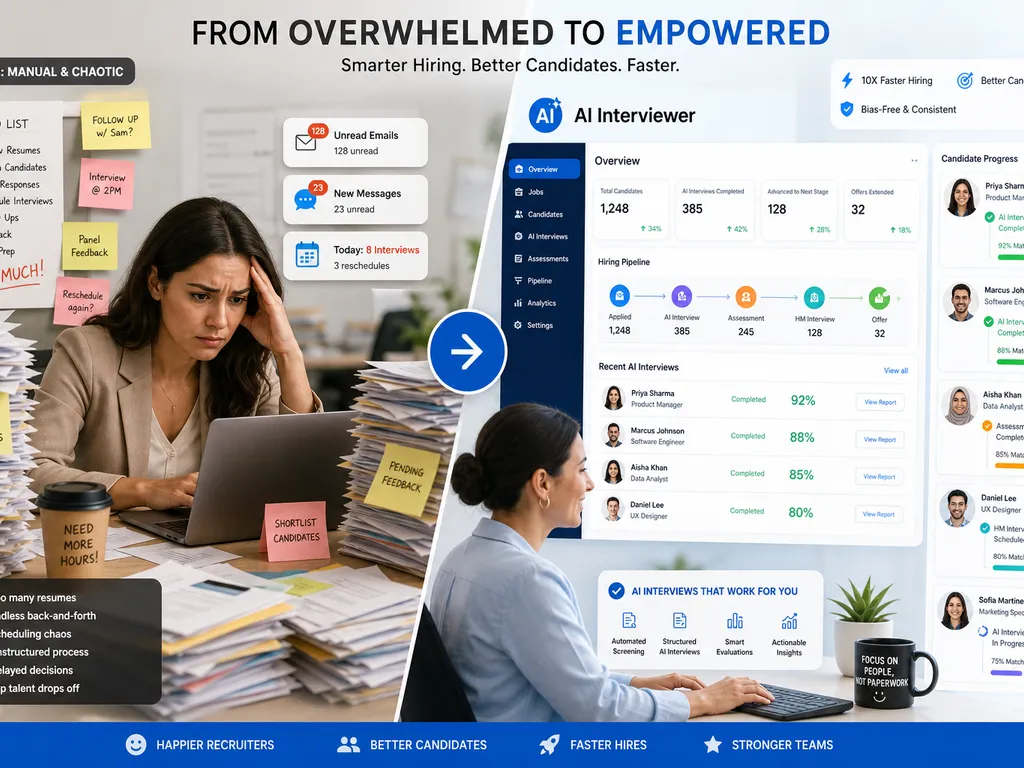
Friendly reminder: silence is not neutral. It shapes how candidates view your company. The Future of Hiring is built on responsiveness, and responsiveness should not depend on whether a recruiter had time between meetings.
Sign 2: Your screening speed is costing you top talent in the Future of Hiring
Top candidates do not sit still. They apply broadly, move quickly, and expect an efficient process. If your first screening touchpoint happens three or four days after application, you are already late. In competitive roles, even a 24-hour delay can reduce your chances of engaging the strongest people.
This is where outdated hiring habits become expensive. Teams often assume the issue is sourcing quality when the real issue is response time. They think there are no great candidates in the market, but in reality those candidates came through and moved on before the process caught up. The Future of Hiring recognizes that speed is not a nice extra. It is a core advantage.
At Interview Screener, we believe the best screening process starts when candidate intent is highest. Right after someone applies, they are paying attention. They are motivated. They are ready to answer questions. That is the moment to screen, not three scheduling emails later. The Future of Hiring meets candidates in that moment with an interview experience that is immediate, structured, and available at scale.
What slow screening usually looks like
- Applications sit untouched until recruiters review them manually
- Candidates are asked to wait for someone to book a call
- Qualified applicants lose interest during back-and-forth coordination
- Hiring managers review shortlists after the best people have exited the process
If that pattern feels familiar, it is not a small operational flaw. It is a strategic gap. The Future of Hiring belongs to teams that can evaluate early and move confidently.
Sign 3: Your process depends too much on subjective first impressions
Manual screening often looks simple on the surface, but it introduces inconsistency from the very first conversation. Different recruiters ask different questions. Notes vary in quality. Decisions are shaped by memory, mood, and time pressure. Even great recruiters can struggle to create consistency when every screening call is live, rushed, and slightly different.
This matters for fairness, but it also matters for quality. When early-stage interviews are unstructured, it becomes harder to compare candidates accurately. Some people get a thorough conversation. Others get ten rushed minutes. Some are assessed on relevant competencies. Others are evaluated on vague impressions. That is not a reliable foundation for hiring. The Future of Hiring replaces variability with a consistent interview framework that treats every candidate with the same level of rigor.
Consistency does not mean making the process cold. It means making it clear. Every applicant should face the same core screening questions, the same criteria, and the same opportunity to show fit. That is how teams reduce noise and make stronger decisions. The Future of Hiring is more human where it counts because it automates the repetitive parts that often introduce inconsistency.
Sign 4: Recruiters are doing admin instead of actual hiring
This one is easy to miss because it becomes normalized. Recruiters spend time reviewing resumes, sending invites, coordinating calendars, conducting repetitive first-round calls, typing notes, and updating stakeholders. The week fills up, but progress feels slow. Everyone is busy, yet roles remain open. That is a classic sign that your team is trapped in manual process work.
Recruiters should be spending their energy where judgment matters most: partnering with hiring managers, calibrating role requirements, building relationships with strong candidates, and guiding final decisions. When they are buried in repetitive screening tasks, the business loses strategic recruiting capacity. The Future of Hiring gives that time back by automating the first interview stage completely.
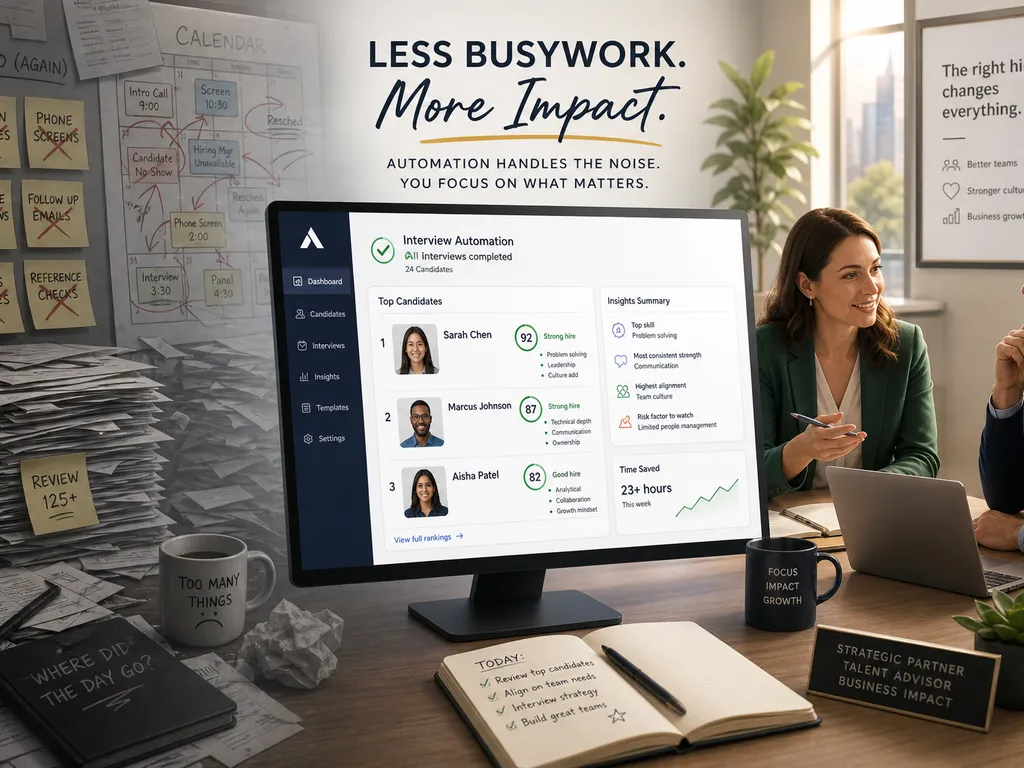
We see the difference clearly. Once screening is automated, teams stop acting like schedulers and start acting like talent leaders again. The Future of Hiring is not about replacing recruiting expertise. It is about removing the drain on that expertise.
Where recruiter time should go in the Future of Hiring
- Aligning with hiring managers on what good looks like
- Improving candidate quality at the top of funnel
- Guiding finalists through a strong experience
- Making faster, better-informed hiring decisions
Sign 5: You cannot scale hiring without adding more people
If every increase in hiring volume requires more recruiters, more coordinators, and more manual screening effort, your model is not scalable. It may work during steady periods, but it breaks under growth, seasonal hiring, or urgent backfills. The problem is not your team. The problem is a process built for a slower era.
A scalable hiring process should handle ten candidates or ten thousand without collapsing into delay and inconsistency. That is one of the clearest markers of the Future of Hiring. AI-driven screening lets every applicant complete a structured interview without waiting for recruiter availability. Your team can then focus on review and selection instead of trying to personally operate every first step.
This also changes the economics of hiring. Instead of solving screening volume with more headcount, teams solve it with better infrastructure. They gain speed without sacrificing consistency. They gain capacity without sacrificing candidate experience. The Future of Hiring is not just faster. It is more resilient.
What modern teams do differently in the Future of Hiring
The best hiring teams are not simply working harder. They are redesigning the process around candidate expectations and recruiter leverage. They understand that first-round screening should be instant, structured, and always on. They know manual interviews are too expensive to use as a universal first filter. And they are no longer willing to let calendar friction decide who moves forward.
That shift is practical, not theoretical. It means candidates can interview as soon as they apply. It means every applicant gets a fair, standardized first assessment. It means recruiters review completed interviews instead of chasing calls. It means hiring managers get stronger signal earlier. This is what the Future of Hiring looks like when it is operational, not just aspirational.
At Interview Screener, our view is simple: if the first stage of hiring still relies on human scheduling and repetitive calls, the process is overdue for change. The Future of Hiring starts when screening no longer depends on calendar luck.
The bottom line on the Future of Hiring
If your hiring process includes candidate ghosting, slow response times, inconsistent screening, admin-heavy recruiter workflows, or limited scalability, it is not just old-fashioned. It is actively holding your team back. These are not isolated frustrations. They are connected symptoms of a manual system that no longer fits how hiring works today.
The good news is that the fix does not require asking recruiters to work longer hours or candidates to lower their expectations. It requires a new first step. The Future of Hiring is faster, fairer, and far more scalable because AI can handle screening interviews immediately and consistently. When that happens, everyone benefits: candidates get momentum, recruiters get time back, and hiring teams make better decisions sooner.
The Future of Hiring is already taking shape in teams that refuse to let outdated screening methods define their results. If your process still feels stuck in 2010, now is the time to change it.
FAQ
What does the Future of Hiring actually mean?
The Future of Hiring means moving away from slow, manual, inconsistent screening and toward a process that is immediate, structured, and scalable. In practice, it means using AI to automate first-round interviews so teams can evaluate candidates faster and more fairly.
How does AI help reduce candidate ghosting?
AI helps by giving candidates an immediate next step after they apply. Instead of waiting for a recruiter to review resumes and schedule calls, applicants can complete a screening interview right away. That keeps them engaged and reduces the silence that often leads to drop-off.
Will AI make hiring feel less personal?
Not when it is used correctly. The Future of Hiring removes repetitive, low-value friction from the process so recruiters can spend more time where human interaction matters most. Candidates get a faster start, and recruiters get more time for meaningful conversations later in the journey.
Is automated screening only useful for high-volume hiring?
No. High-volume teams benefit quickly, but any company that wants faster response times, more consistent screening, and better recruiter efficiency can benefit. The Future of Hiring applies anywhere manual first-round interviews create delays or inconsistency.
What is the biggest sign that we need to change our process now?
If strong candidates regularly disappear before your team finishes screening them, that is your clearest signal. The Future of Hiring rewards speed and consistency. If your process cannot deliver both, it is time to modernize.