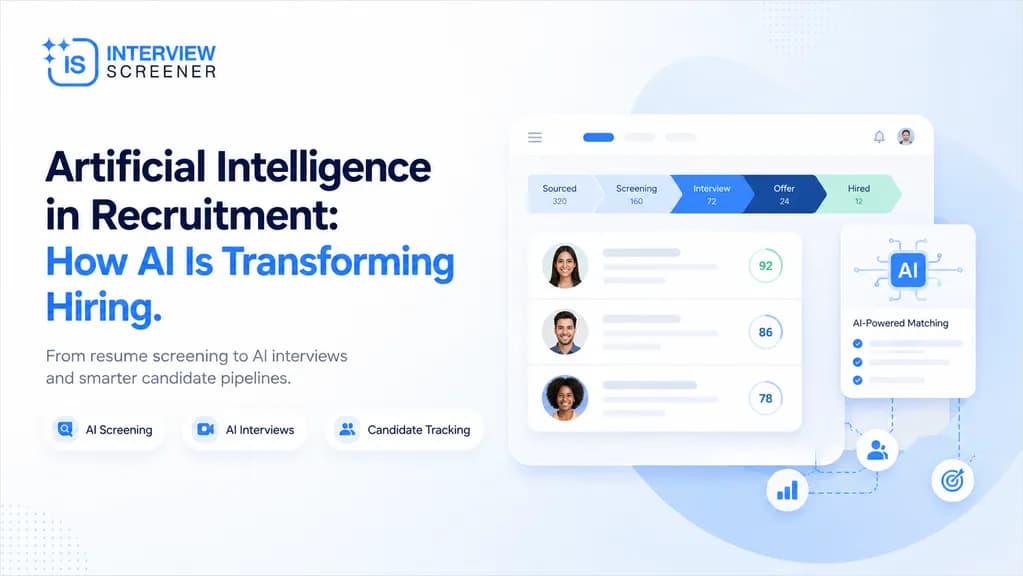
Artificial intelligence in recruitment is becoming part of everyday hiring.
Adoption is growing quickly. SHRM's 2025 Talent Trends research found that 43% of organizations were using AI for HR tasks, up from 26% in 2024. Recruiting was the most common use case, with 51% using AI to support recruitment.
AI works best as a decision-support tool. It can organize evidence and improve consistency, while people remain responsible for context, relationships, and final decisions.
What Is Artificial Intelligence in Recruitment?
Artificial intelligence in recruitment refers to AI-powered software that supports or automates hiring tasks, including:
- Job description creation
- Resume parsing and AI resume screening
- Candidate sourcing and matching
- Interview scheduling and pre-screening
- AI-led interviews
- Candidate evaluation and reporting
- Applicant tracking and recruitment analytics
These systems can process candidate information quickly, but speed does not guarantee accuracy or fairness. Outputs should be reviewed and corrected when necessary.
How to Implement Al Recruitment Responsibly
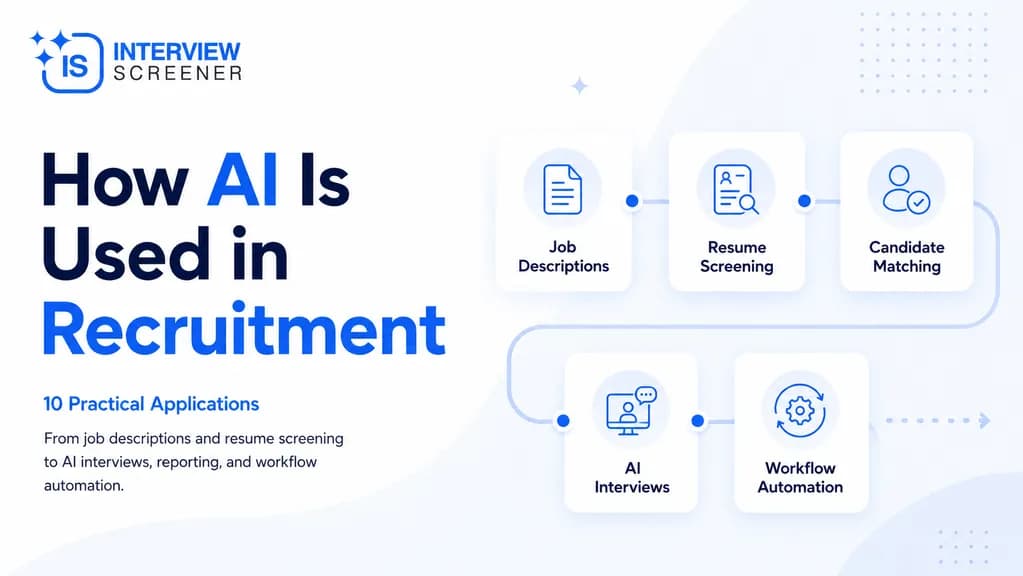
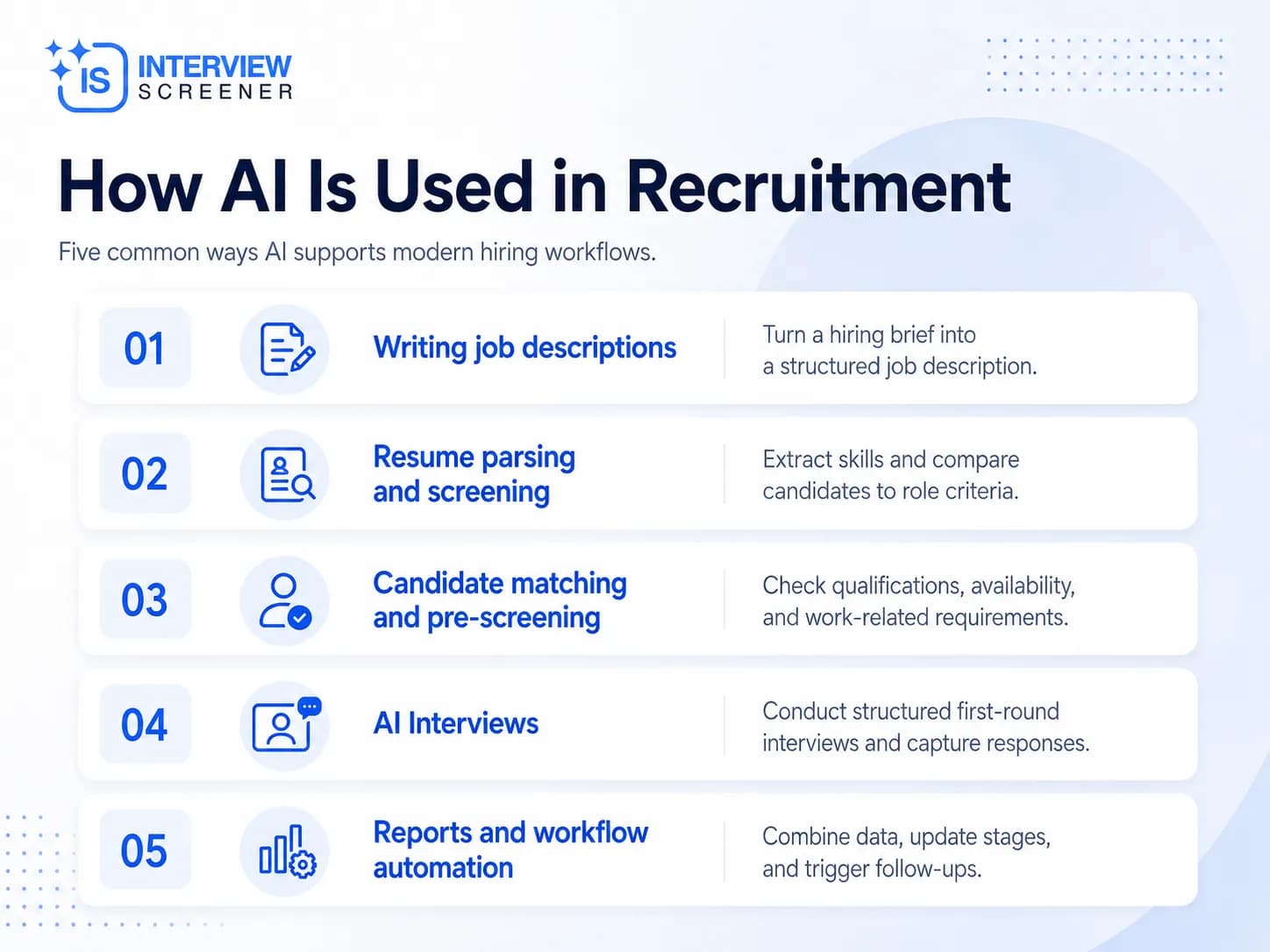
How AI Is Used in Recruitment
Writing job descriptions
AI can turn a hiring brief into a structured job description based on the role, required skills, responsibilities, and experience level.
SHRM found that 66% of organizations using AI for recruiting used it to write job descriptions.
Recruiters should still review each draft because inflated requirements or unclear wording can discourage applicants.
Resume parsing and screening
Resume parsing extracts skills, education, certifications, employment history, and job titles from a candidate's CV.
AI resume screening compares that information with job-related criteria. The system may highlight relevant applicants, summarize strengths, or rank candidates for further review.
SHRM reported that 44% of organizations using AI in recruiting applied it to resume screening, while 32% used it to automate candidate searches.
Screening scores should guide prioritization, not create an automatic rejection list.
Career changers, applicants with employment gaps, and candidates using unusual resume formats may require additional human review.
Candidate matching and pre-screening
AI candidate matching compares an applicant's qualifications with the requirements of an open role.
The comparison may include skills, certifications, location, language, and availability. Pre-screening can also confirm work authorization, notice period, or shift availability.
The criteria should be specific and connected to the job. Vague measures such as "personality fit" or similarity to previous employees can introduce bias.
AI interviews
AI interview software can conduct a structured first-round interview without requiring a recruiter to attend live.
Candidates receive a link, answer role-related questions, and may receive relevant follow-ups. The platform can record or transcribe responses and create a structured candidate report.
This can reduce scheduling delays. Candidates should be told how AI is used, what data is collected, and whether a human reviews the result.
Candidate reports and workflow automation
AI can combine resume data, interview transcripts, screening outcomes and recruiter notes into one candidate report.
Recruitment automation can also send interview invitations, update pipeline stages, track interview completion and trigger follow-up messages.
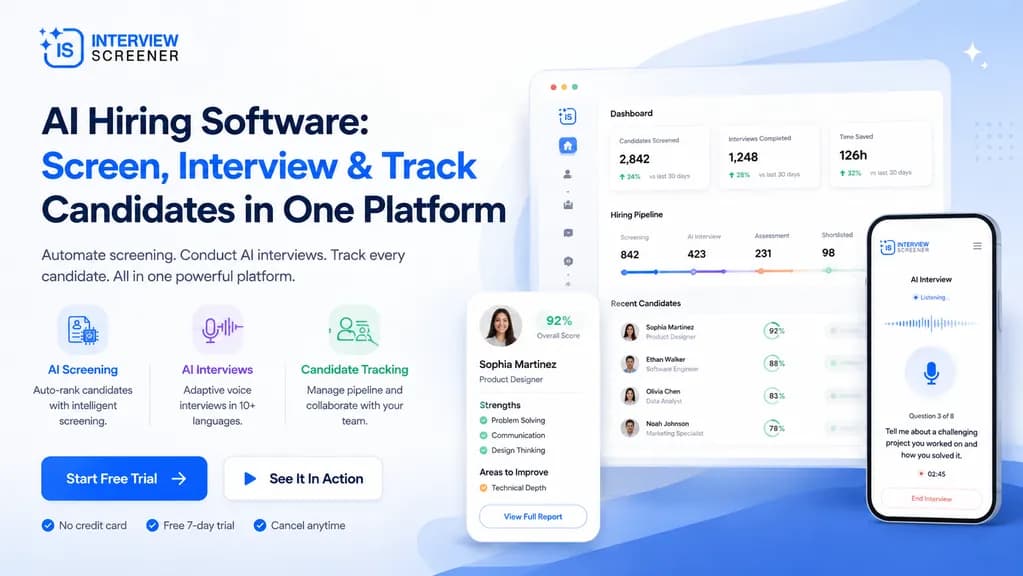
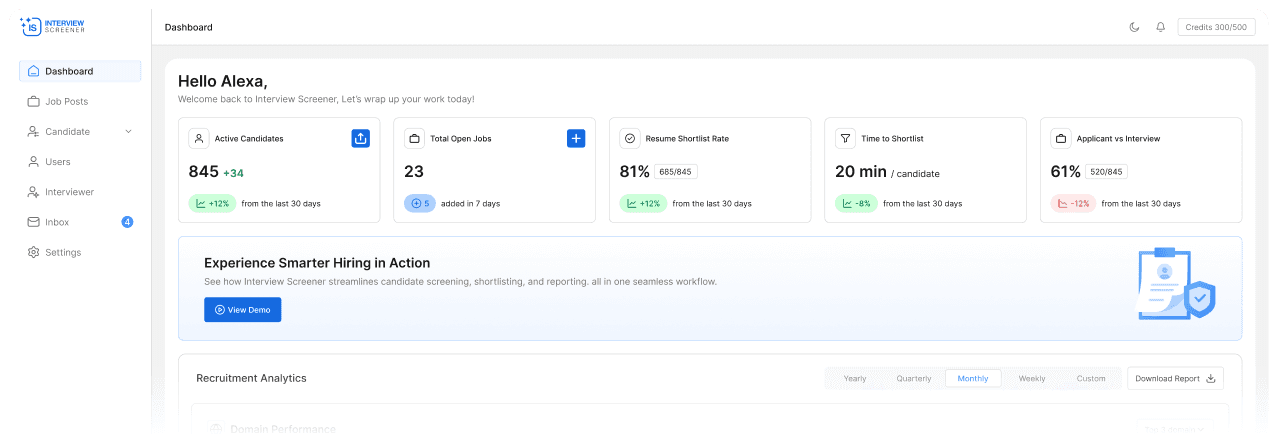
Interview Screener brings resume screening, structured AI interviews, candidate reports and applicant tracking into one workflow. Its purpose is to reduce repetitive early-stage work while keeping recruiters in control.
How Al Is Used in Recruitment
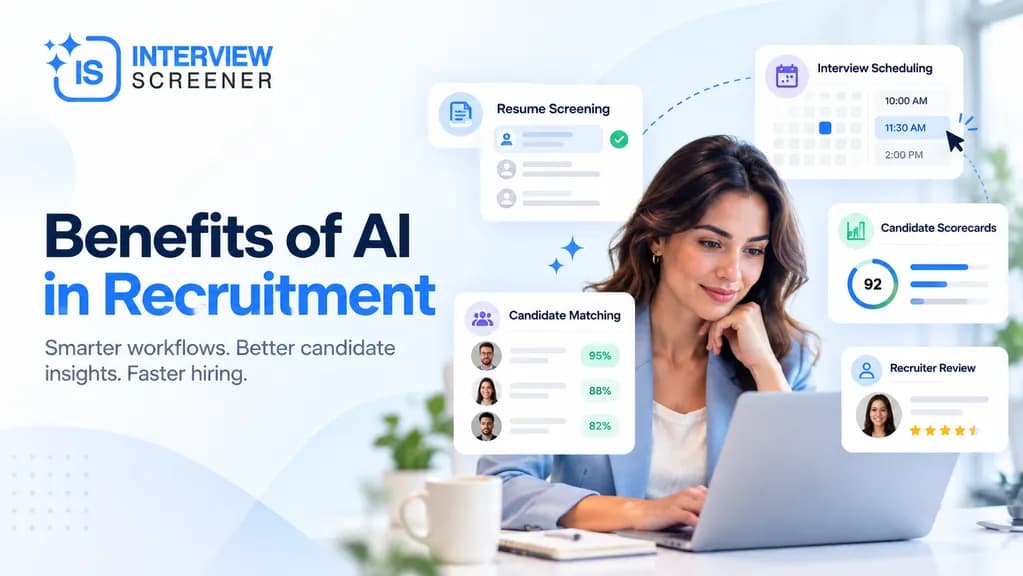
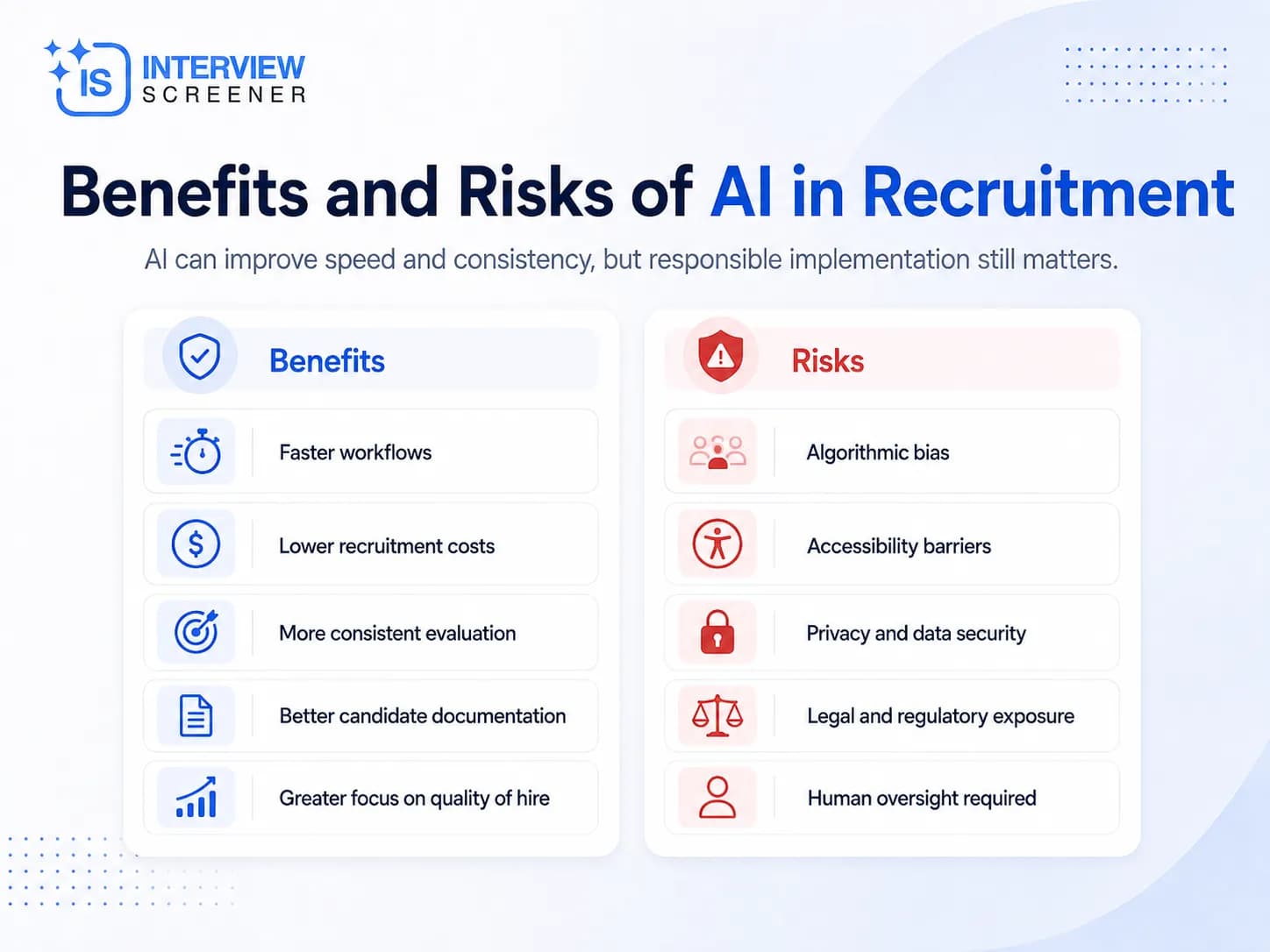
Benefits of AI in Recruitment
Faster recruitment workflows
The strongest evidence for AI adoption is currently related to time savings and efficiency.
SHRM found that 89% of HR professionals whose organizations used AI in recruiting said it saved time or increased efficiency.
LinkedIn's 2025 Future of Recruiting report found that talent acquisition professionals using generative AI reported an average 20% reduction in workload, roughly equal to one working day per week.
LinkedIn also found that 73% of talent acquisition professionals believed AI would change how companies hire. At the time of the research, 37% were experimenting with generative AI or actively integrating it into recruitment.
These self-reported findings are not guaranteed outcomes, but they help explain rising investment in recruitment automation.
Lower recruitment costs
Automation can reduce the time spent organizing resumes, arranging interviews, sending repetitive messages, and preparing candidate reports.
In SHRM's research, 36% of respondents using AI for recruiting said it helped reduce recruitment, interviewing or hiring costs. A further 24% said AI improved their ability to identify top candidates.
Savings depend on hiring volume, implementation quality and software costs.
More consistent evaluation
Structured screening can apply the same questions and evaluation criteria to candidates applying for the same role.
This may reduce variation caused by interviewer fatigue, rushed calls or incomplete notes.
Consistency does not automatically guarantee fairness. However, a structured process is often easier to review, audit and improve than an undocumented process based heavily on personal impressions.
Better candidate documentation
Transcripts and criteria-based reports create a clearer record and help recruiters compare applicants using evidence.
Better documentation can also improve collaboration between recruiters, hiring managers and department leaders.
Instead of relying on scattered notes, teams can review the same candidate information, interview responses and competency findings.
Greater focus on quality of hire
LinkedIn found that 89% of talent acquisition professionals believed measuring quality of hire would become more important.
However, only 25% felt highly confident in their organization's ability to measure it effectively. Another 61% believed AI could help improve quality-of-hire measurement.
AI can organize hiring data, but the organization must still define which performance, retention, and role-specific outcomes matter.
Risks and Limitations of AI Recruitment
Algorithmic bias
AI can reproduce unfair patterns found in historical data, evaluation rules, prompts or training examples.
The U.S. Equal Employment Opportunity Commission states that federal employment discrimination laws still apply when employers use AI.
Its guidance identifies resume screening and recorded video interviews as areas where automated tools may affect job applicants. It also explains that employers may still be required to provide reasonable accommodations.
Employers should test outcomes, examine differences between candidate groups, and avoid claiming that an AI recruitment system is automatically bias-free.
Accessibility barriers
Video, voice, timed or keyboard-based assessments may disadvantage some candidates.
Employers should provide accommodations or alternative assessments when appropriate.
Recruiters should also be able to review original responses and correct errors caused by transcription quality, accents, technical problems or language differences.
Privacy and data security
Recruitment platforms may process sensitive information, including resumes, contact details, recordings, transcripts and evaluation results.
Benefits and Risks of Al in Recruitment
Organizations should review:
- Data encryption
- User permissions
- Data retention periods
- Candidate deletion requests
- Third-party subprocessors
- Model providers
- Cross-border data transfers
Candidate data should only be collected when it serves a clear and legitimate recruitment purpose.
Legal and regulatory exposure
AI hiring requirements vary by jurisdiction.
New York City's Local Law 144 guidance states that covered automated employment decision tools require a bias audit completed within the previous year.
Employers must also make information about the audit publicly available and provide required notices to candidates or employees.
Under the European Union's AI Act, AI tools used for employment and recruitment, including CV-sorting software, can be classified as high-risk.
Covered systems may face requirements involving risk management, data quality, transparency, recordkeeping, and human oversight.
This article provides general information, not legal advice. Employers should seek qualified guidance in every location where they hire.
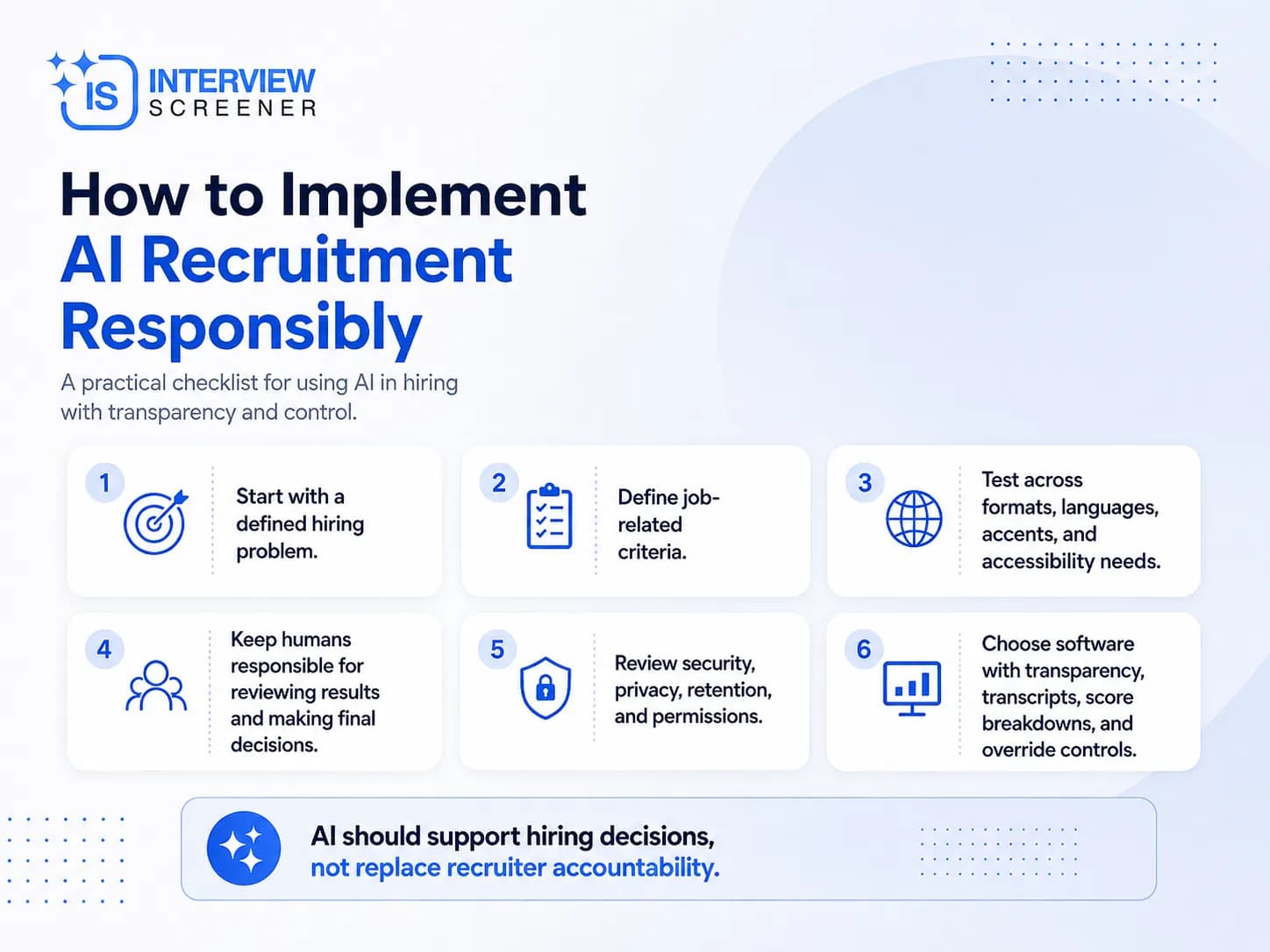
How to Implement AI Recruitment Responsibly
Start with a defined hiring problem rather than purchasing a tool simply because it uses AI.
The problem might involve slow resume screening, inconsistent first-round interviews, poor candidate response times, or limited recruiter capacity.
Define the job-related criteria the system will evaluate.
Test the system across different resume formats, career histories, languages, accents, and accessibility needs.
- Recruiters should remain responsible for:
- Reviewing AI-generated results
- Correcting inaccurate information
- Managing exceptions
- Responding to accommodation requests
- Investigating unusual scoring patterns
- Making final hiring decisions
Organizations can also use the reference. NIST AI Risk Management Framework as a governance reference.
The framework encourages organizations to govern, map, measure, and manage AI risks throughout the technology lifecycle. It is designed to help organizations improve the trustworthiness of AI systems and manage risks to individuals and society.
How to Choose AI Recruiting Software
Look for a platform that provides transparency rather than only showing a final candidate score.
Recruiters should be able to review:
- Original resumes
- Interview responses
- Transcripts
- Evaluation criteria
- Score breakdowns
- Supporting evidence
They should also be able to override, correct, or disregard AI recommendations.
Review the platform's security, accessibility, language support, workflow coverage, and applicant tracking integrations.
Most importantly, choose software that solves a measurable bottleneck. The best AI recruiting software should make recruiters more capable, not less accountable.
Frequently Asked Questions
Can AI replace recruiters?
AI can automate repetitive recruitment tasks, but it cannot replace human judgment, relationship building, negotiation, or final hiring responsibility.
Can AI reduce recruitment bias?
AI may reduce some inconsistency by applying the same job-related framework to candidates.
However, it can also introduce or reproduce bias. Testing, transparency, outcome monitoring and human oversight remain essential.
Can AI conduct candidate interviews?
Yes. AI interview systems can ask questions, capture or transcribe responses and generate structured reports.
Employers should disclose the process, explain how the information will be used and maintain meaningful human review.
Is AI recruitment legal?
AI recruitment software can be used legally, but the requirements depend on the jurisdiction, tool and hiring process.
Employers may need to consider discrimination laws, accessibility requirements, privacy rules, candidate notices, bias audits and data-protection obligations.
Final Takeaway
Artificial intelligence in recruitment can help employers screen applicants faster, improve documentation and create more consistent early-stage workflows.
Research suggests that many organizations are already experiencing time and efficiency benefits.
Successful implementation still depends on job-related criteria, accessible processes, secure data handling, transparency, and clear human accountability.
AI should support better hiring decisions. It should never make recruiters less responsible for them.