How is AI used in recruitment today?
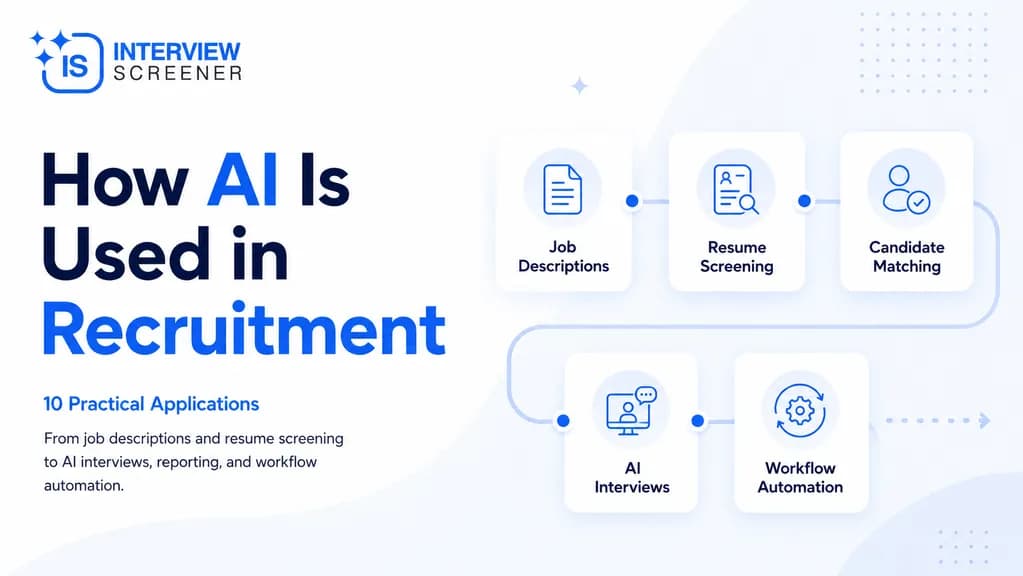
Employers use AI to write job descriptions, process resumes, screen candidates, conduct first-round interviews, and automate repetitive hiring tasks.
Adoption is growing quickly. According to SHRMʼs 2025 Talent Trends research, 43% of organizations use AI for HR activities, up from 26% in 2024. Recruitment is the most common HR application, with 51% of organizations using AI to support recruiting.
Among organizations using AI in recruitment:
- 66% use it to write job descriptions
- 44% use it to screen resumes
- 32% use it to automate candidate searches
- 31% use it to customize job postings
- 29% use it to communicate with applicants
The strongest systems do more than generate text. They reduce administrative work, organize candidate evidence, and create a more structured hiring process.
For a broader look at the benefits, risks, and compliance considerations, read our complete guide to artificial intelligence in recruitment.
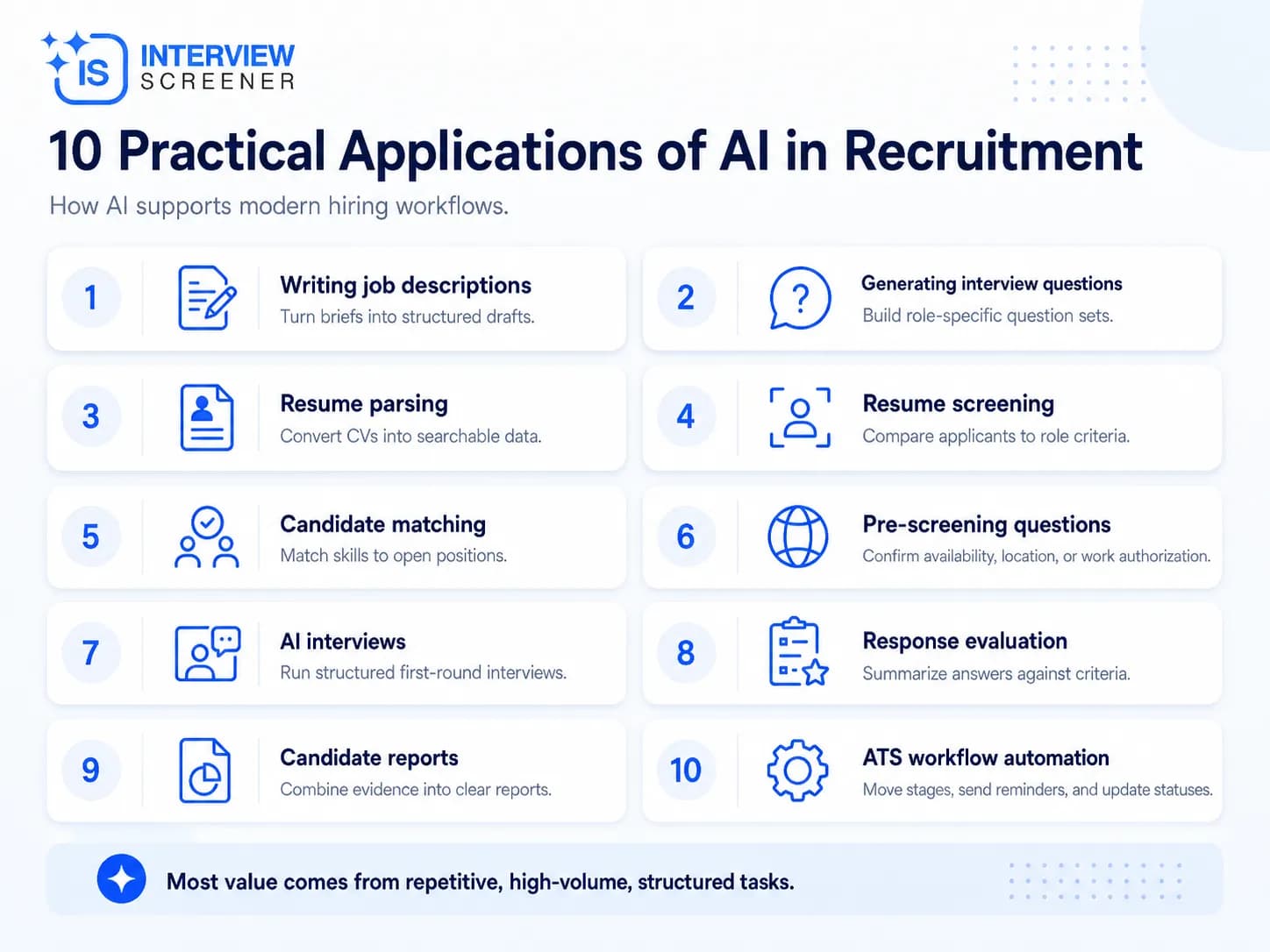
1. Writing and Improving Job Descriptions
Recruiters can give an AI tool the role title, responsibilities, required skills, location, and experience level.
The system can then produce a structured first draft.
AI may also identify unclear requirements, repetitive wording, missing responsibilities, and inconsistent terminology.
This is currently the most common recruiting use case reported by SHRM, with 66% of organizations using recruitment AI applying it to job descriptions.
Recruiters should still review every draft. An AI-generated description may sound professional while containing unnecessary qualifications or inaccurate expectations.
2. Generating Interview Questions
AI can create interview questions from a job description, competency framework, or hiring objective.
For a sales manager, the questions might cover forecasting, negotiation, coaching, and customer retention.
For a software engineer, they may focus on debugging, system design, technical decision-making, and collaboration.
Recruiters should approve the final question set before candidates see it.
AI can accelerate interview preparation, but human review ensures that each question is relevant, appropriate, and connected to the role.
3. Parsing Resumes Into Structured Data
Resume parsing converts an uploaded CV into searchable candidate information.
The system may extract:
- Employment history
- Education
- Skills
- Certifications
- Languages
- Previous job titles
- Projects
- Employment dates
This reduces manual data entry and makes large candidate databases easier to organize.
Parsing errors are still possible. Graphics, tables, unusual layouts, and non-standard job titles may cause information to be missed or classified incorrectly.
Recruiters should retain the original resume and allow incorrect information to be corrected.
4. Screening Candidates Against Job Requirements
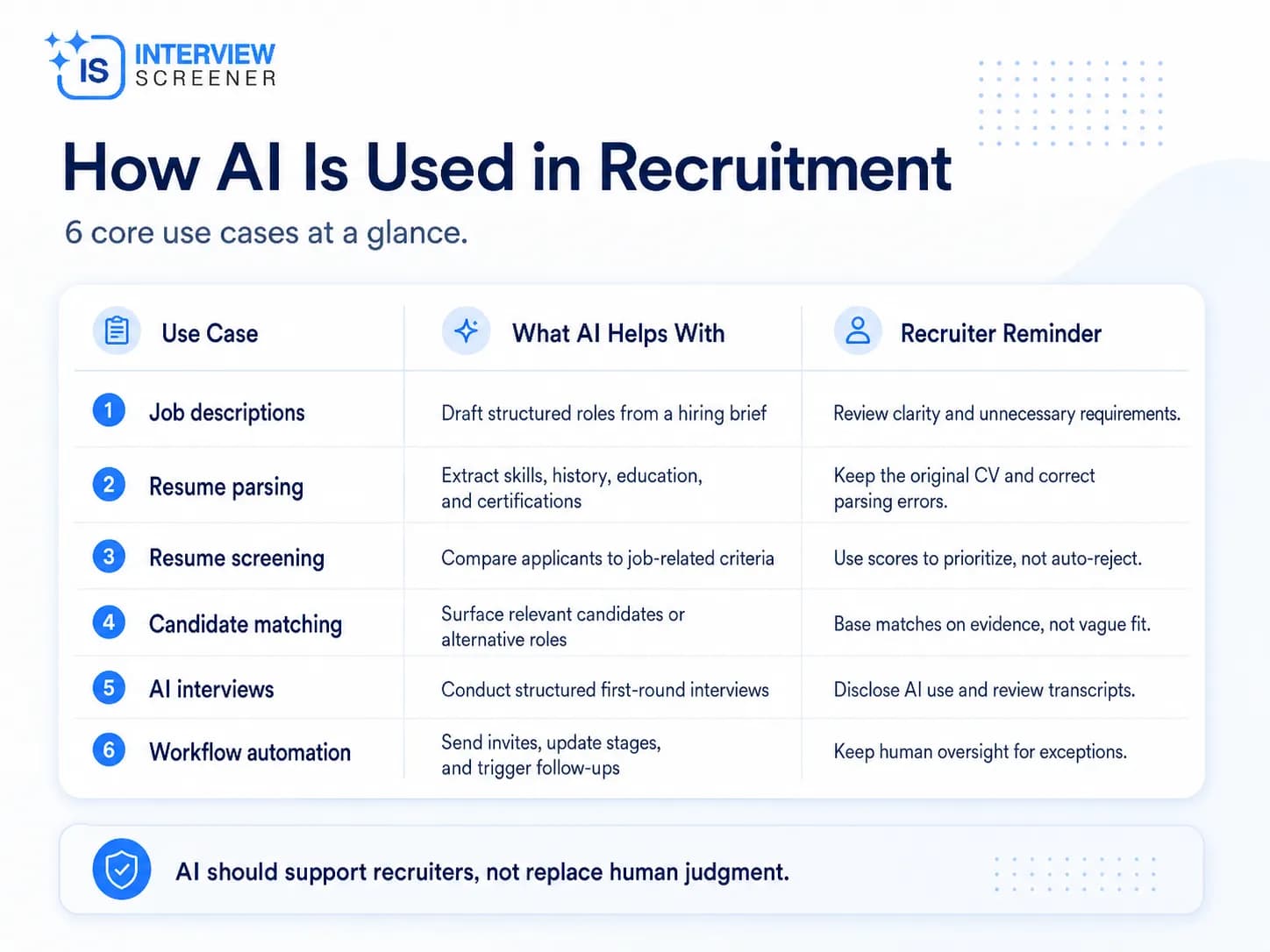
AI resume screening compares applicant information with predefined role requirements.
The system may look for required skills, relevant experience, certifications, language ability, location or work authorization.
SHRM found that 44% of organizations using AI in recruitment applied it to resume screening. Another 24% said AI improved their ability to identify top candidates.
Screening scores should help recruiters prioritize applications, not automatically determine who is unsuitable.
Career changers, applicants with employment gaps and candidates with transferable skills may require additional human review.
The U.S. Equal Employment Opportunity Commission confirms that federal employment discrimination laws continue to apply when employers use AI to screen resumes or evaluate recorded interviews.
How Al Is Used in Recruitment
5. Matching Candidates With Open Positions
Candidate matching evaluates how closely a personʼs experience and skills align with one or more vacancies.
This is useful for employers and recruitment agencies managing several open roles.
A candidate who is unsuitable for the original position may be relevant to another opportunity.
SHRM reported that 32% of organizations using AI in recruitment applied it to automated candidate searches.
A useful matching system should explain its recommendation by showing evidence such as relevant experience, certifications, technical knowledge or language ability.
Recruiters should avoid relying on vague concepts such as personality fit or similarity to previous employees.
6. Automating Pre-Screening Questions
AI-supported pre-screening collects basic qualification information before a live interview.
Questions may cover:
- Availability
- Notice period
- Salary expectations
- Shift preferences
- Location
- Work authorization
- Required licences
- Willingness to travel
This can reduce the time recruiters spend asking every applicant the same questions.
It is particularly useful in high-volume recruitment, where hundreds of candidates may apply for similar positions.
Candidates should be told whether their responses could automatically advance or stop their application. Important outcomes should remain open to human review.
7. Conducting Structured AI Interviews
AI interview software can conduct a first-round interview without requiring a recruiter to attend live.
Candidates receive a link and answer role-specific questions at a suitable time. The system may record or transcribe responses, ask follow-up questions and generate a structured report.
This can reduce scheduling delays and support candidates across different time zones.
LinkedInʼs 2025 Future of Recruiting research, based on responses from 1,271 recruiting professionals across 23 countries, found that professionals already using generative AI reported an average workload reduction of 20%. That is approximately one working day per week.
The employer should disclose the use of AI, provide accessible instructions and offer an alternative process when appropriate.
10 Practical Applications of Al in Recruitment
8. Evaluating Interview Responses
AI can compare candidate answers with evaluation criteria established before the interview.
For a project manager, the framework might examine planning, prioritization, risk management, stakeholder communication and conflict resolution.
The output may include a summary, competency score, strengths, concerns and supporting evidence.
Recruiters should be able to inspect the original response instead of relying only on a score.
LinkedIn found that 93% of talent acquisition professionals considered accurate skills assessment important to improving quality of hire. Companies conducting the most skills based searches were 12% more likely to report a quality hire in LinkedInʼs platform analysis.
Evaluation should focus on job-related evidence rather than characteristics unrelated to performance.
9. Creating Structured Candidate Reports
AI can combine information from the resume, screening stage and interview into one candidate report.
The report may contain:
- Resume summary
- Job alignment
- Skills evidence
- Interview transcript
- Competency findings
- Potential gaps
- Recruiter notes
- Suggested next steps
Structured reports help recruiters and hiring managers review the same evidence.
They also reduce dependence on memory, inconsistent note-taking and informal impressions.
Reports should clearly separate candidate-provided information, AI-generated interpretations and human decisions. Recruiters should be able to correct inaccurate summaries.
10. Automating Applicant Tracking Workflows
Recruitment automation connects individual hiring activities into one workflow.
AI recruiting software can:
- Send interview invitations
- Assign candidates to recruiters
- Move applicants between stages
- Send reminders
- Update candidate statuses
- Record completed interviews
- Trigger follow-up messages
- Identify pipeline delays
SHRM found that 29% of organizations using AI in recruitment applied it to candidate communication. Overall, 89% of HR professionals using AI for recruiting said it saved time or increased efficiency.
Automation can prevent qualified candidates from being overlooked because an email was not sent or an applicant tracking system was not updated.
These workflows still need safeguards so incorrect stage changes or automated messages can be reversed.
Where AI Creates the Most Recruitment Value
AI is most useful when recruitment work is repetitive, high-volume, time-sensitive or based on clearly defined criteria.
Common examples include resume parsing, qualification checks, scheduling, transcription, first-round screening, candidate reporting and pipeline updates.
AI is less reliable when decisions require empathy, negotiation, unusual context or a deep understanding of team dynamics.
This is why AI should support recruiters rather than operate without meaningful oversight.
How to Use AI Responsibly in Recruitment
Start by defining the problem the technology should solve.
Recruiters should establish job-related criteria before candidates are screened or evaluated. They must also be able to review evidence, correct mistakes and override AI recommendations.
Recent International Labour Organization research warns that some HR systems are built around unclear objectives, incomplete data and opaque processes. These weaknesses can distort decisions and reinforce existing inequalities.
Organizations can use the NIST AI Risk Management Framework to structure AI governance. The voluntary framework focuses on managing risks throughout the design, deployment and evaluation of AI systems.
Legal obligations also vary by jurisdiction.
Under New York City Local Law 144, covered automated employment decision tools must undergo a bias audit within one year of use. Employers must also publish information about the audit and provide required notices.
The European Union AI Act classifies certain recruitment tools, including CV-sorting software, as high-risk. Relevant obligations include risk controls, documentation, data quality, traceability and human oversight.
Organizations should seek appropriate legal advice before using automated systems for consequential hiring decisions.
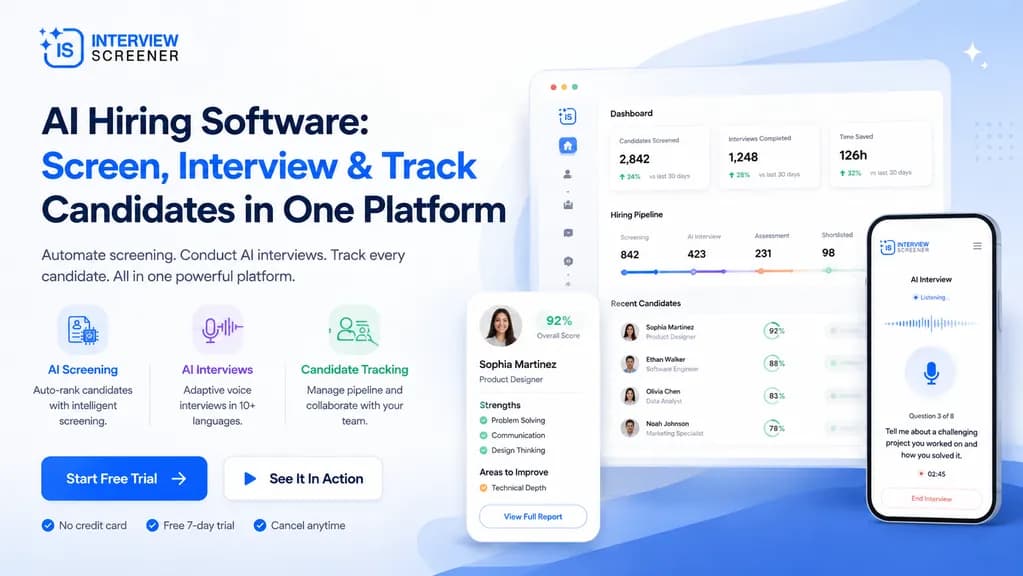
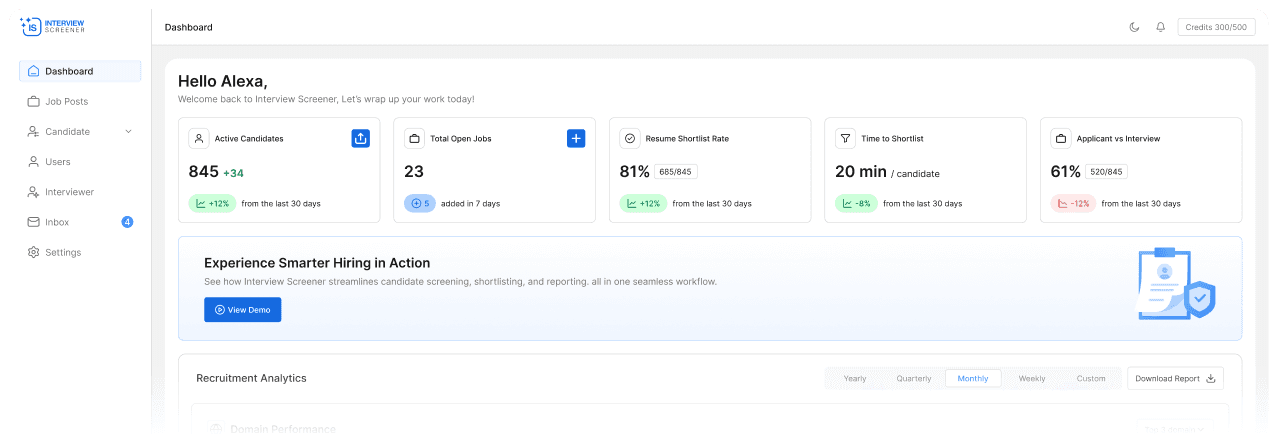
How AI Is Used in Interview Screener
Interview Screener applies AI throughout the early recruitment workflow.
Hiring teams can:
- Create roles and interview questions.
- Upload or collect candidate resumes.
- Evaluate candidate-job alignment.
- Apply screening criteria.
- Invite qualified candidates to AI interviews.
- Record and evaluate responses.
- Generate structured candidate reports.
- Manage candidate progress through the built-in ATS.
The objective is not to let AI make the final hiring decision.
It is to reduce repetitive screening work and give recruiters organized information for human review.
Explore Interview Screenerʼs AI recruitment platform.
Frequently Asked Questions
How is artificial intelligence used in recruitment?
Artificial intelligence is used for job description creation, resume parsing, candidate screening, matching, pre-screening, structured interviews, response evaluation, reporting, and workflow automation.
Can AI interview candidates?
Yes. AI interview tools can ask structured questions, record or transcribe responses, generate follow-up questions, and create candidate reports.
Employers should disclose the process and maintain human oversight.
Can AI replace recruiters?
AI can automate repetitive work, but recruiters remain necessary for context, candidate relationships, negotiation, accommodations, and final decisions.
Is AI recruitment fair?
AI recruitment is not automatically fair.
Outcomes depend on the criteria, data, technology, accessibility, testing, and human oversight used by the employer.
Final Takeaway
How is AI used in recruitment most effectively?
It handles structured tasks that consume time but do not always require live recruiter involvement.
AI can process resumes, check basic qualifications, conduct first-round interviews, organize candidate evidence, and keep hiring workflows moving.
The best results come from combining automation with transparency, accessibility, and human judgment.
AI should help recruiters make better-informed decisions, not remove their responsibility for those decisions.