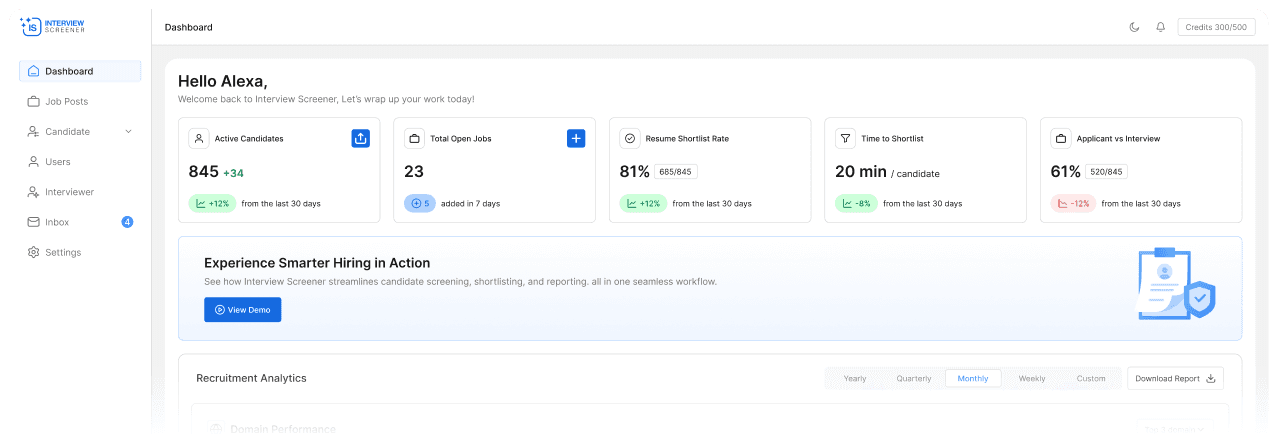

High-Volume Hiring & Scale Optimization: How We Remove Screening Bottlenecks Without Burning Out HR
High-Volume Hiring & Scale Optimization starts with one operational truth: when hundreds or thousands of applications arrive every day, manual screening fails first. We solve that by automating interview workflows, standardizing early-stage evaluation, and moving qualified candidates forward without adding recruiter fatigue, delay, or inconsistency.
Most hiring teams do not break because demand is high. They break because every resume review, phone screen, scheduling exchange, and follow-up depends on human availability. That model cannot support modern High-Volume Hiring & Scale Optimization. It creates backlog, slows decisions, introduces bias through rushed judgment, and pushes HR teams into constant triage mode.
We built Interview Screener for this exact pressure. Our approach to High-Volume Hiring & Scale Optimization replaces repetitive screening work with AI-led interviews that run continuously, evaluate every candidate consistently, and surface the strongest applicants fast. Instead of asking recruiters to do more, we redesign the funnel so less manual effort is required in the first place.
Why High-Volume Hiring & Scale Optimization fails in traditional hiring funnels
In high-application environments, the problem is rarely sourcing alone. The real issue is downstream capacity. A team may generate a healthy pipeline for graduate roles, seasonal retail staffing, customer support expansion, or franchise growth, then lose momentum the moment resumes hit the inbox. High-Volume Hiring & Scale Optimization fails when intake is fast but screening is slow.
We see the same friction points repeatedly. Recruiters spend hours scanning resumes with limited context. Coordinators chase candidates for availability. Hiring managers receive uneven shortlists because different screeners value different signals. Strong applicants drop off while teams are still arranging first conversations. The funnel becomes crowded, but not productive.
- Resume queues grow faster than recruiters can review them
- Phone screens consume hours without producing consistent data
- Scheduling delays increase candidate abandonment
- Manual shortlisting amplifies inconsistency and hidden bias
- HR teams enter reactive mode and burnout accelerates
High-Volume Hiring & Scale Optimization requires more than speed. It requires a repeatable operating model that can absorb spikes in volume without sacrificing quality. That means automating first-touch interviews, standardizing evaluation criteria, and ranking candidates based on the same structured framework every time.
High-Volume Hiring & Scale Optimization for daily inbound resume surges
If your team receives hundreds of resumes per day, the first objective is not to read them faster. It is to stop depending on resume review as the primary screening mechanism. For High-Volume Hiring & Scale Optimization, we recommend shifting the earliest qualification stage into automated interviews that can run asynchronously and at scale.
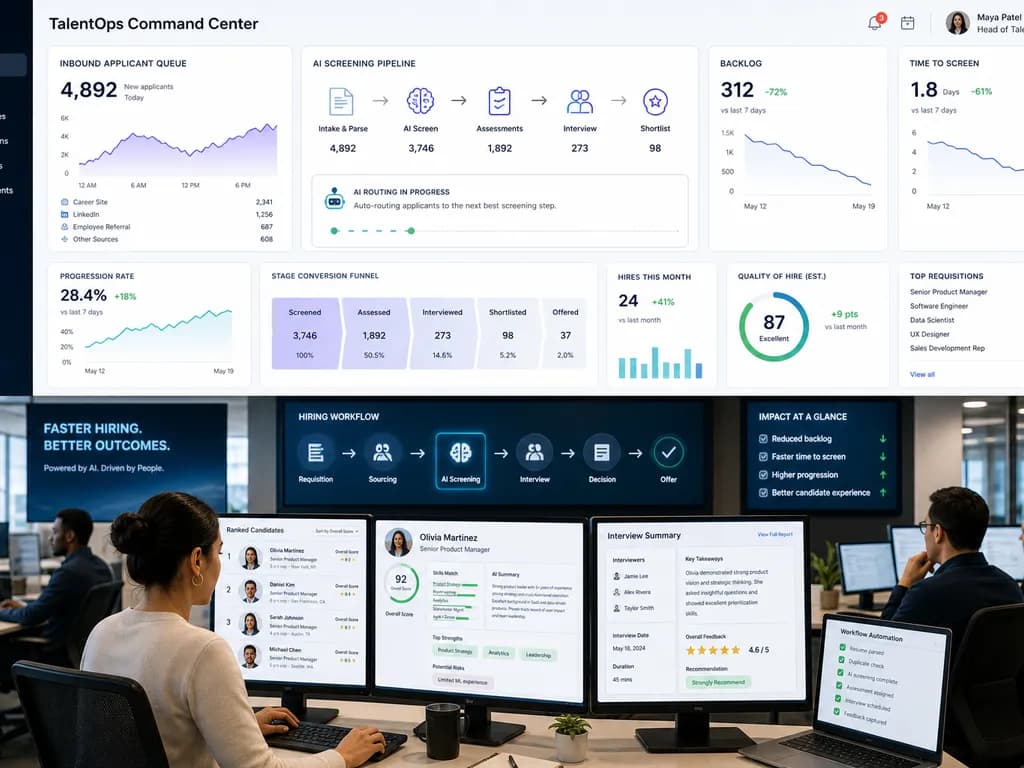
With Interview Screener, candidates can be invited immediately into an AI-led screening interview. They respond on their own schedule. The system captures structured answers, applies consistent evaluation logic, and produces a clear comparison set for recruiters and hiring managers. This is how High-Volume Hiring & Scale Optimization becomes practical instead of theoretical.
The benefit is immediate. Recruiters no longer spend the day sorting documents and coordinating calls. Instead, they review interview-backed candidate outputs, focus on edge cases, and move finalists forward with confidence. Every applicant gets the same initial experience. Every hiring team gets cleaner data earlier in the process.
What to automate first for High-Volume Hiring & Scale Optimization
- Candidate invitation to first-round screening
- Asynchronous AI interview delivery
- Standardized scoring against role criteria
- Automatic shortlist generation
- Advance or reject workflows based on thresholds
- Hiring team visibility into candidate responses and fit signals
This sequencing matters. High-Volume Hiring & Scale Optimization improves most when the highest-volume, lowest-leverage tasks are removed first. In most organizations, those tasks are resume filtering, introductory calls, and scheduling coordination.
The blueprint for automated campus recruitment
Campus hiring creates one of the clearest use cases for High-Volume Hiring & Scale Optimization. Graduate programs attract large numbers of applicants with similar education profiles, limited work history, and uneven resume quality. Manual review makes teams slow and subjective. Strong candidates get lost because there is simply too much surface-level similarity to process quickly.
We approach campus recruitment by replacing resume-heavy screening with structured, automated interviews and voice-based assessment. This allows hiring teams to evaluate communication, motivation, problem solving, and role readiness at scale. High-Volume Hiring & Scale Optimization in campus programs depends on hearing more than seeing. Voice and response quality often reveal more than a polished graduate resume ever could.
A practical campus workflow looks like this: applications enter the funnel, candidates receive instant interview invitations, AI conducts first-round screening, responses are scored against predefined hiring criteria, and recruiters receive ranked groups for review. Instead of manually comparing thousands of nearly identical profiles, teams act on evidence from actual candidate interaction.
How voice technology strengthens High-Volume Hiring & Scale Optimization
Voice-led screening adds a powerful layer to early evaluation. It helps teams assess communication clarity, confidence, responsiveness, and job-relevant thinking in a consistent environment. For customer-facing, support, sales, and operational roles, this is especially valuable. High-Volume Hiring & Scale Optimization becomes more accurate when screening reflects how candidates actually communicate, not just how they format a document.
This also improves fairness. Every graduate applicant receives the same questions, the same process, and the same scoring logic. Recruiters are no longer forced to make snap decisions from overloaded inboxes. That consistency is essential when applicant numbers spike.
High-Volume Hiring & Scale Optimization for retail and customer service peak seasons
Peak hiring periods expose every weak point in a manual process. Retail, hospitality, and customer service teams often need to hire quickly across many locations while turnover remains high. In that environment, asynchronous screening is not optional. It is mandatory for High-Volume Hiring & Scale Optimization.
Why? Because candidates apply outside business hours. Managers are busy running operations. Recruiters cannot coordinate hundreds of calls in a compressed timeline. If screening depends on calendars, hiring slows exactly when demand is highest. Asynchronous AI interviews solve this by allowing candidates to complete screening immediately, without waiting for a recruiter to become available.
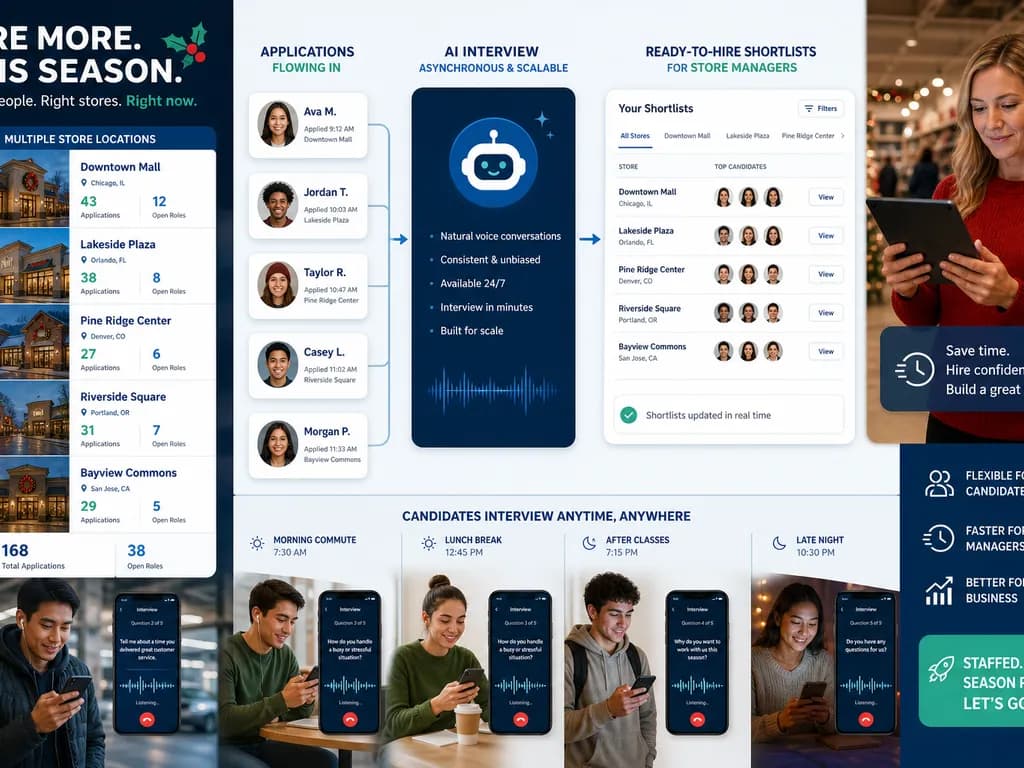
For frontline roles, speed matters, but so does consistency. High-Volume Hiring & Scale Optimization in seasonal hiring means every applicant should be screened against the same availability requirements, communication standards, shift expectations, and role-fit questions. That is difficult to maintain through rushed phone calls. It is easy to enforce through automated screening workflows.
- Candidates screen as soon as they apply
- Recruiters review ranked applicants instead of raw applications
- Store and service managers receive faster, cleaner shortlists
- Time-to-hire drops because scheduling friction disappears
- Hiring quality improves because every candidate is measured consistently
This is where Interview Screener creates operational leverage. We help teams keep the funnel open, moving, and measurable even when applicant volume surges for short periods. That is the heart of High-Volume Hiring & Scale Optimization.
A step-by-step guide to reducing time-to-hire by 60%
High-Volume Hiring & Scale Optimization is most effective when it is implemented as a process redesign, not a patch on top of old habits. If the goal is a dramatic reduction in time-to-hire, we recommend a simple sequence.
Step 1: Define knockout criteria and success signals
Start with the role requirements that truly matter. Availability, location, communication ability, compliance basics, role-specific judgment, and motivation should be clear before any workflow is built. High-Volume Hiring & Scale Optimization depends on evaluating the right signals early.
Step 2: Automate first-round interviews
Replace introductory phone screens with AI-led interviews. This removes the largest time block from recruiter calendars and creates standardized candidate data from the beginning.
Step 3: Score consistently and rank automatically
Use structured scoring to group candidates by fit. This is where High-Volume Hiring & Scale Optimization shifts from simple automation to real decision support. Recruiters should spend time on prioritization, not repetitive filtering.
Step 4: Route only qualified candidates to humans
Not every applicant needs recruiter time. By advancing only candidates who meet the threshold, teams protect capacity and focus on interviews that are more likely to convert into hires.
Step 5: Monitor bottlenecks weekly
Measure stage-by-stage delay. If candidates complete screening quickly but manager review is slow, fix that handoff. High-Volume Hiring & Scale Optimization is sustained through operational visibility, not guesswork.
When these steps are followed, time-to-hire drops because wasted motion disappears. Recruiters do less admin work. Managers see stronger candidates sooner. Applicants move through the funnel before interest fades. That is how we engineer High-Volume Hiring & Scale Optimization into everyday hiring operations.
What teams gain when High-Volume Hiring & Scale Optimization is done right
The visible benefit is speed, but the deeper value is control. Teams gain a hiring process that can scale without constant expansion of recruiter workload. They gain consistency in screening. They gain better auditability around why candidates advanced. Most importantly, they gain resilience during hiring spikes.
We have seen that High-Volume Hiring & Scale Optimization changes the role of HR from overwhelmed processor to strategic operator. Instead of drowning in inbound activity, teams can focus on decision quality, stakeholder alignment, and candidate experience where human judgment matters most.
Interview Screener is designed for exactly this shift. We automate candidate interviews end to end so organizations can handle high applicant volumes with less friction, less bias from rushed reviews, and far less burnout across HR and hiring teams.
FAQ
What is High-Volume Hiring & Scale Optimization?
High-Volume Hiring & Scale Optimization is the practice of designing hiring workflows that can process large numbers of applicants quickly and consistently without increasing manual recruiter effort at the same rate.
How does AI reduce HR burnout in high-volume hiring?
AI removes repetitive screening tasks such as first-round interviews, initial qualification checks, candidate ranking, and workflow routing. This allows HR teams to focus on final-stage decisions instead of constant administrative overload.
Why is asynchronous screening important for seasonal hiring?
Asynchronous screening allows candidates to complete interviews immediately after applying, regardless of recruiter or manager availability. That speeds up the funnel and prevents delays during peak hiring periods.
Can automated screening work for campus recruitment?
Yes. It is especially effective for campus hiring because it helps teams evaluate large numbers of similar profiles through structured interviews and voice responses rather than relying only on resumes.
How does Interview Screener support High-Volume Hiring & Scale Optimization?
Interview Screener fully automates candidate interviews using AI, helping teams screen at scale, rank applicants consistently, reduce time-to-hire, and manage hiring demand without adding recruiter burnout. High-Volume Hiring & Scale Optimization becomes achievable when screening no longer depends on human scheduling and manual first-round review.