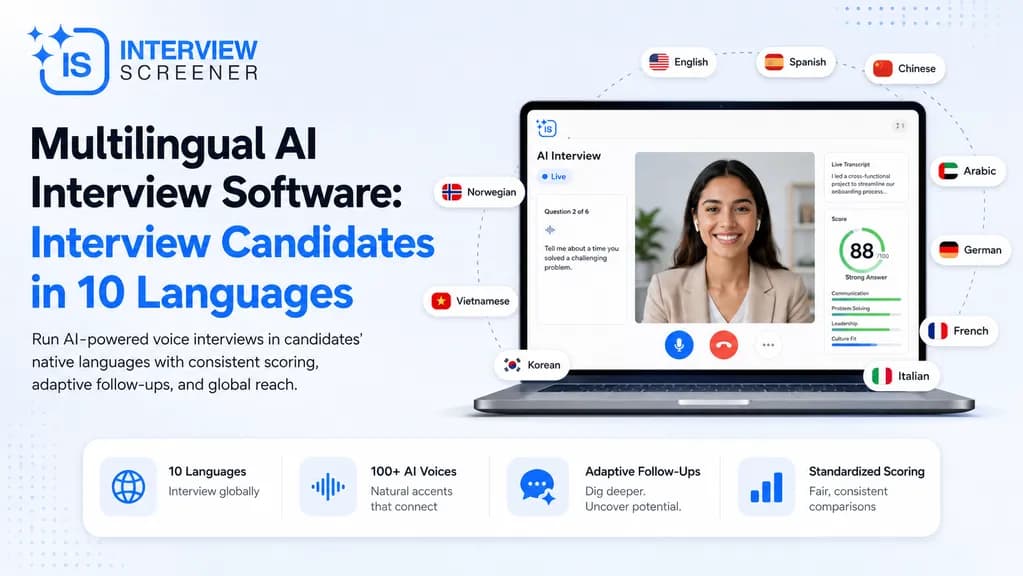
Global hiring has a language problem. When your interview process only runs in English, you filter out qualified candidates who could excel in the role. Multilingual AI interview software removes that barrier.
This guide explains what the technology does, how it works, which languages matter, and how to evaluate a platform. It is written for recruiters, HR teams, and talent leaders hiring across borders.
What Is Multilingual AI Interview Software?
Multilingual AI interview software is a recruitment tool that conducts automated interviews in more than one language. It uses AI voice engines to ask questions, understand responses, and score candidates — all in the applicant's chosen language.
The software handles three functions across every supported language:
- Asking questions with natural, human-sounding AI voices.
- Understanding responses through speech recognition and language models.
- Evaluating answers against consistent, role-specific criteria.
This means a candidate in Seoul and a candidate in Madrid can complete the same structured interview, each in their native tongue, and be scored on the same standard.
How It Differs From Translated Interviews
Translation tools convert text after the fact. Multilingual AI interviews are native from the start. The AI conducts the entire conversation in the target language, including follow-up questions.
This preserves nuance. Idioms, technical terms, and conversational tone stay intact, which manual translation often loses.
How Does Multilingual AI Interviewing Work?
The workflow mirrors a standard AI interview, with language selected up front. Here is the typical process:
- Set the language. You choose the interview language per job or let candidates select their own.
- Configure the AI voice. Pick a voice engine and accent that fits the region.
- Generate questions. The AI creates role-specific questions in the chosen language.
- Candidate interviews. The AI conducts a real-time voice interview, adapting follow-ups to answers.
- Score and report. Responses are evaluated and returned in a standardized report.
What Powers the Technology
Modern platforms combine several AI systems:
- Large language models (such as GPT-5, Claude 4.5, or Gemini 2.5) for reasoning and question generation.
- Text-to-speech engines (such as ElevenLabs, OpenAI, or Minimax) for natural voices.
- Speech recognition to transcribe and interpret candidate answers.
Together, these produce interviews that feel conversational rather than robotic.
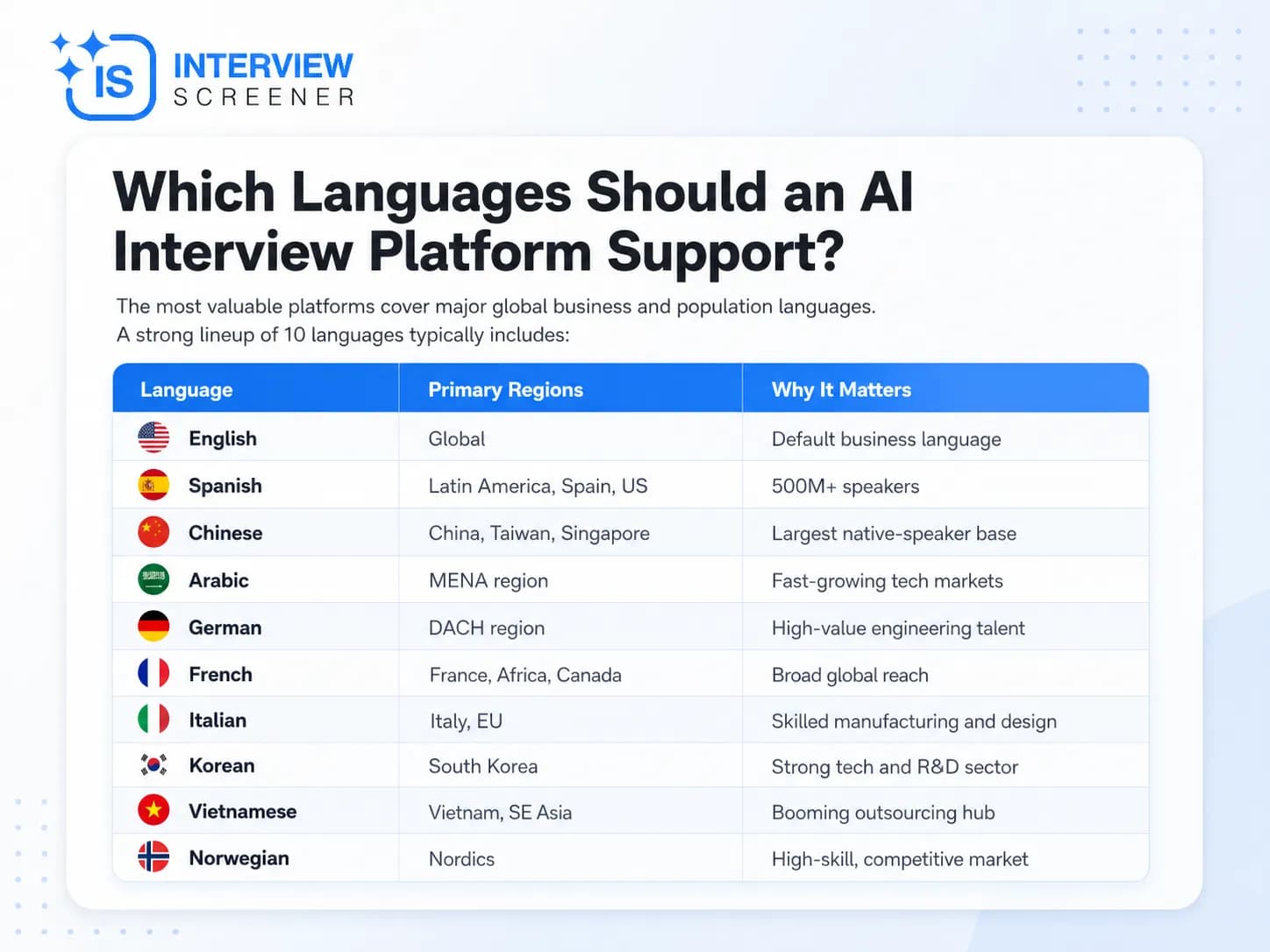
Language supported by Interviewscreener
Why Use Multilingual AI Interview Software?
Hiring in one language limits your reach. Multilingual screening delivers measurable advantages.
Key benefits include:
- Wider talent pool. Reach candidates who are qualified but not fluent in English.
- Better candidate experience. Applicants perform better and feel respected in their native language.
- Consistency at scale. Every candidate gets the same structured interview, regardless of language.
- Reduced bias. Standardized scoring evaluates skills, not accent or fluency.
- Faster global hiring. No need to recruit or schedule bilingual interviewers.
- Lower cost. One platform replaces multiple regional interview processes.
The Non-Native Speaker Advantage
Non-native English speakers often underperform in English-only interviews — not from lack of skill, but from language friction. Native-language interviews surface their true ability.
This is especially valuable in technical roles, where communication style should not overshadow competence.
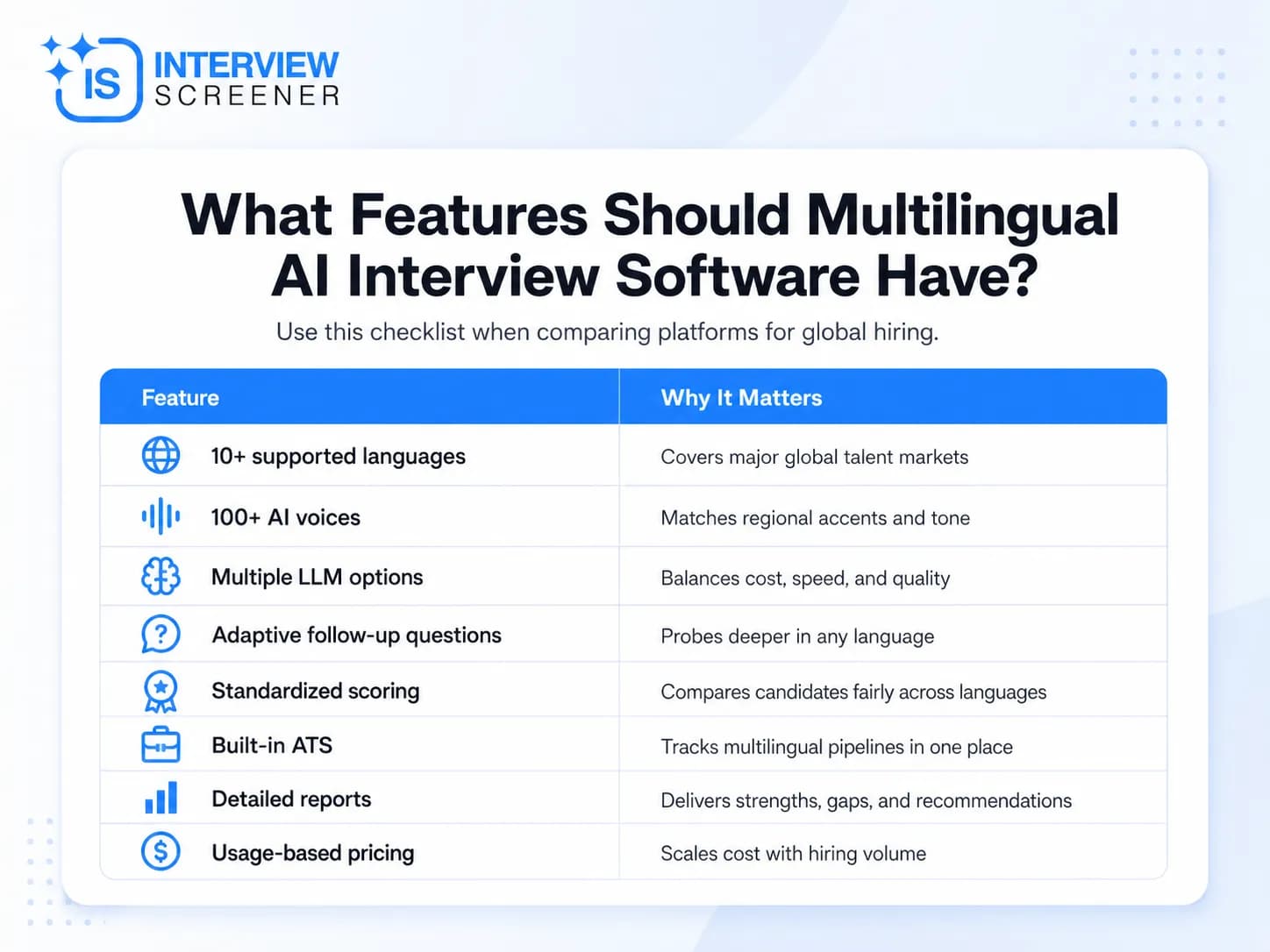
What Features Should Multilingual AI Interview Software Have?
Must-Have vs. Nice-to-Have
Treat language coverage, adaptive questioning, and standardized scoring as must-haves. Without them, you lose the fairness and depth that justify AI interviewing.
Multiple voice engines and LLM choices are strong differentiators. They let you tune quality and cost per region.
Who Benefits Most From Multilingual AI Interviews?
Any organization hiring beyond a single language market gains value. The strongest fits include:
- Global enterprises hiring across continents.
- Remote-first companies recruiting worldwide.
- Outsourcing and BPO firms screening high volumes in Asia and Latin America.
- Staffing agencies placing candidates across regions.
- Multinational SMBs expanding into new markets.
If your candidate pipeline crosses borders, multilingual AI screening is the most efficient way to interview at scale. It removes the language bottleneck without adding headcount.
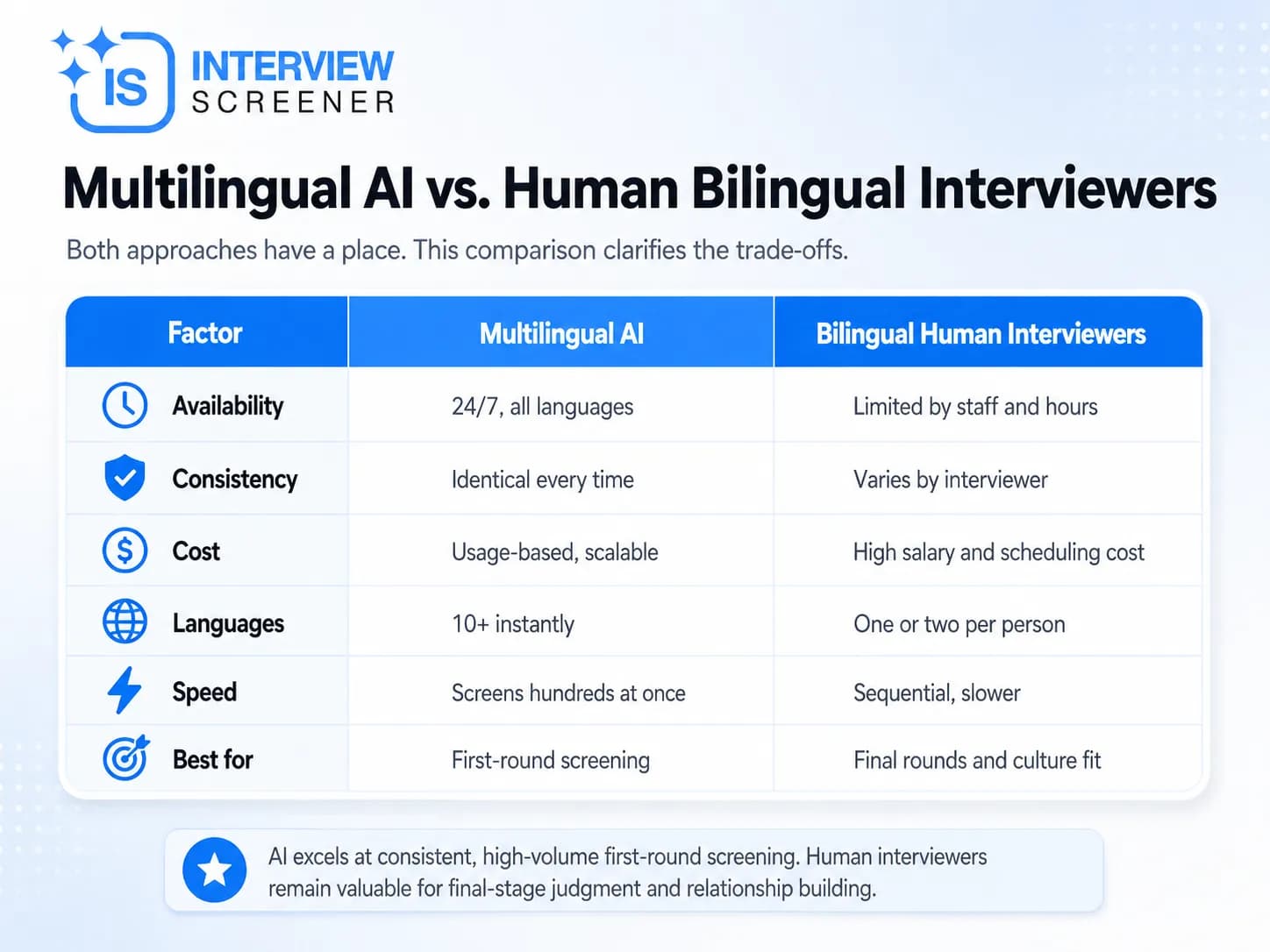
Multilingual AI vs. Human Bilingual Interviewers
Frequently Asked Questions
How many languages can AI interview software support?
Leading platforms support up to 10 languages, including English, Spanish, Chinese, Arabic, German, French, Italian, Korean, Vietnamese, and Norwegian. Many also offer 100+ AI voices, so candidates can interview in their native language with a natural-sounding voice.
Can candidates choose their own interview language?
Yes. Most multilingual AI interview platforms let recruiters set a language per job or allow candidates to select their preferred language. This ensures each applicant interviews in the language where they can perform best.
Is a multilingual AI interview as accurate as an English one?
Yes. Quality platforms use large language models that reason natively in each supported language. Scoring criteria stay consistent across languages, so candidates are evaluated on the same standard regardless of the language they choose.
Does multilingual AI interviewing reduce hiring bias?
It helps reduce bias. By interviewing candidates in their native language, the software prevents fluency from overshadowing actual skill. Standardized scoring further ensures applicants are judged on qualifications, not accent or language ability.
How much does multilingual AI interview software cost?
Costs depend on the provider. Usage-based platforms are the most transparent, charging per interview minute based on the chosen voice engine and LLM. This lets teams scale multilingual hiring without fixed per-seat contracts.
Multilingual AI interview software turns language from a barrier into an advantage. It lets you screen qualified candidates worldwide, consistently and affordably, in the language where they shine. For any team hiring globally, it is the fastest way to widen your talent pool without adding cost.
Ready to interview candidates in their native language? Try multilingual AI interviews free and reach talent in 10 languages today.